Showing posts with label Religion and faith: Christianity. Show all posts
Monday, May 18, 2015
Tsarnaev verdict confirms: US is no "Christian" nation
Last week the sentence came down: Death to Dzhokhar Tsarnaev.
The verdict, zealously sought by federal prosecutors, dispels any right-wing pretense that the United States is a "Christian" nation. Or it ought to, anyway.
Consider: Tsarnaev is no longer a legitimate threat to others. Live or die, the man will never again be able to harm anyone. Not even himself. Howsoever long his life may last, he will spend his days in a prison cell, isolated from humanity. If he lacks remorse, as the prosecution asserted, he will have ample opportunity to learn it in the long years of emptiness that await him. (Ask Sirhan Sirhan about that!) And if he did somehow maintain his hatred over the course of his life? If he continued his defiance and anger? Would that not be a fate worse than death? Decades of impotent rage! God save us all!
None of this is to say that human beings should not do what they can to protect themselves. For example, in the case of Osama bin Laden, death was necessary for a dangerous man who remained a threat to civilization. There was small difference between him and a renegade grizzly bear (an analogy I've made before.)
But how quickly do we desert our purported faiths in favor of primal satisfaction? (I refer Christians to Matthew 5:39).
Fifty-eight percent of the residents of the (very blue and very Catholic) state of Massachusetts, including family members of some of the victims, oppose the sentence. But in the larger pool of the United States' general citizenry 53% support it. And the justice system came down on their side.
It's a fascinating and revealing phenomenon. And, make no mistake: the sentence is not about Tsarnaev or even what he did.
It's about us. It's about who we are.
Killing this man fulfills some primal need humans have for vengeance. It's residual behavior from our Stone Age state-of-existence. In the ~10,000 years since civilizations first arose, there has been much progress, but barbarous relics like the death penalty remain.
We're not a Christian nation. Can we let go of that ridiculous notion?
Friday, November 22, 2013
A Christian failure
Here's a true story about something that happened in the Portland Metro area not too long ago. I've changed names where appropriate.
For African women, getting one's hair done is more than a cosmetic activity --it's a social event. The process of having extensions braided into kinky African wool is a time-consuming activity that can often take 8 to 10 hours. The custom is that the women spend all day at it while watching Nollywood movies and eating African food.
Several years ago, a woman, an immigrant from sub-Saharan Africa and a Christian, came to our house so that Maty (coiffure extraordinaire) could braid the woman's hair. I'll call the woman "Fatou." The woman brought her 3-year-old daughter (I'll call her "Susie") with her.
At one point during the day, as Maty and Fatou were gabbing away in French, Susie looked at me and said, apropos of nothing: "Stevie put his penis right here!" She pointed at her vagina. All conversation stopped at that point.
"What?" I asked, uncomfortably.
She repeated the statement.
In the confused silence that followed, Fatou spoke. "It's true. She was raped." In response to Maty's and my gaping incomprehension, she shrugged. "The counselor told me to let her talk about it, if she wants."
Fatou then proceeded to tell us the story.
When Fatou's family came to America from West Africa in the early 00's, they were having a hard time adjusting to the new culture. A local Christian church, I can't remember the denomination, took the struggling family under its wing. They brought the family to their place of worship, invited them to social events, and made them feel welcome.
The family was grateful for the kindness and immersed themselves into their new community.
Susie's parents both worked and so they needed day-care for their daughter. Fortunately, a prominent family in the church provided day-care. The mother of that family home-schooled her own children and also oversaw a day-care center that catered to the children of other church members.
Susie joined other toddlers at the church family's home while Fatou and her husband went to their wage-earning jobs.
The family providing the day-care included a teenage boy of about 15 years whom I'll call "Stevie." Stevie had been home-schooled his entire life. On occasion, when his mother would leave the house on some errand or another, Stevie was asked to watch over the children.
On one such occasion, something bad happened.
On that day, Fatou picked up her daughter after work and was driving home when Susie told her about it. Fatou couldn't believe it at first. But as her daughter said more, Fatou began to panic. She took her daughter home, gave her a bath, and called the police.
Although Fatou later learned that giving her daughter a bath might have hindered the investigation, nonetheless, there was enough compelling evidence on Susie's clothing and on her body that a warrant was issued for Stevie's arrest.
The day-care family, as it happened, had left that very afternoon for the Oregon coast, to take part in a Christian convention. So Portland police called the Newport authorities and asked them to arrest Stevie and have him brought back to Portland. Apparently, the arrest occurred in front of the entire Christian community during their convention.
Stevie was found guilty. At the trial, the judge stated that he had never before seen a case where a 3-year-old girl had been raped. I don't know the details of the sentencing, but Stevie was incarcerated and assigned "sex offender" status, which will be with him for a long time to come.
It's a horrible story, but it doesn't end there. One of the most tragic and disappointing aspects of the whole affair was the reaction of the local Christian church.
Like good Christians, they rallied around the prominent day-care-providing family. I think that was noble and kind. That family was devastated by the act of their wayward son and was, no doubt, in sore need of support.
But the African family, Fatou's and Susie's family, suddenly found themselves shunned by the Christian community they thought had befriended them. Invitations to events dried up. People avoided them at church services. They were ostracized.
Eventually, the African family felt compelled to leave the church and find another place to worship.
It's a sad and tragic tale. A family in need comes to a community for help, is assaulted by one of its members, and then is turned away for exposing the community to shame.
Make of it what you will.
For African women, getting one's hair done is more than a cosmetic activity --it's a social event. The process of having extensions braided into kinky African wool is a time-consuming activity that can often take 8 to 10 hours. The custom is that the women spend all day at it while watching Nollywood movies and eating African food.
Several years ago, a woman, an immigrant from sub-Saharan Africa and a Christian, came to our house so that Maty (coiffure extraordinaire) could braid the woman's hair. I'll call the woman "Fatou." The woman brought her 3-year-old daughter (I'll call her "Susie") with her.
At one point during the day, as Maty and Fatou were gabbing away in French, Susie looked at me and said, apropos of nothing: "Stevie put his penis right here!" She pointed at her vagina. All conversation stopped at that point.
"What?" I asked, uncomfortably.
She repeated the statement.
In the confused silence that followed, Fatou spoke. "It's true. She was raped." In response to Maty's and my gaping incomprehension, she shrugged. "The counselor told me to let her talk about it, if she wants."
Fatou then proceeded to tell us the story.
When Fatou's family came to America from West Africa in the early 00's, they were having a hard time adjusting to the new culture. A local Christian church, I can't remember the denomination, took the struggling family under its wing. They brought the family to their place of worship, invited them to social events, and made them feel welcome.
The family was grateful for the kindness and immersed themselves into their new community.
Susie's parents both worked and so they needed day-care for their daughter. Fortunately, a prominent family in the church provided day-care. The mother of that family home-schooled her own children and also oversaw a day-care center that catered to the children of other church members.
Susie joined other toddlers at the church family's home while Fatou and her husband went to their wage-earning jobs.
The family providing the day-care included a teenage boy of about 15 years whom I'll call "Stevie." Stevie had been home-schooled his entire life. On occasion, when his mother would leave the house on some errand or another, Stevie was asked to watch over the children.
On one such occasion, something bad happened.
On that day, Fatou picked up her daughter after work and was driving home when Susie told her about it. Fatou couldn't believe it at first. But as her daughter said more, Fatou began to panic. She took her daughter home, gave her a bath, and called the police.
Although Fatou later learned that giving her daughter a bath might have hindered the investigation, nonetheless, there was enough compelling evidence on Susie's clothing and on her body that a warrant was issued for Stevie's arrest.
The day-care family, as it happened, had left that very afternoon for the Oregon coast, to take part in a Christian convention. So Portland police called the Newport authorities and asked them to arrest Stevie and have him brought back to Portland. Apparently, the arrest occurred in front of the entire Christian community during their convention.
Stevie was found guilty. At the trial, the judge stated that he had never before seen a case where a 3-year-old girl had been raped. I don't know the details of the sentencing, but Stevie was incarcerated and assigned "sex offender" status, which will be with him for a long time to come.
It's a horrible story, but it doesn't end there. One of the most tragic and disappointing aspects of the whole affair was the reaction of the local Christian church.
Like good Christians, they rallied around the prominent day-care-providing family. I think that was noble and kind. That family was devastated by the act of their wayward son and was, no doubt, in sore need of support.
But the African family, Fatou's and Susie's family, suddenly found themselves shunned by the Christian community they thought had befriended them. Invitations to events dried up. People avoided them at church services. They were ostracized.
Eventually, the African family felt compelled to leave the church and find another place to worship.
It's a sad and tragic tale. A family in need comes to a community for help, is assaulted by one of its members, and then is turned away for exposing the community to shame.
Make of it what you will.
Wednesday, April 10, 2013
Who is Lucifer?
![]() |
| Prideful Lucifer |
It's a fascinating story. But, like so much of Christian belief, I can't accept it as literal. If there is truth to be had, as far as I'm concerned, it is by examining the story as metaphor.
But I put the question to a good friend of mine, a practicing Christian and a man of considerable intellect. "Is Lucifer a personality?"
His reply: "I'm agnostic on that."
"What about your church?" I asked.
"I think they're agnostic on that, too."
An honest, if dissatisfying answer.
| South side of Saint Stephen's Catholic, up on 41st |
But in my reality, Lucifer is a metaphor for the evil that exists in all of us: our propensity toward self-infatuation, our lust for power, our malignant indifference toward everything that is not us.
Christians, please weigh in! Muslims, as well! Is there an actual devil? A living personification of evil? Or is it something different?
Odd synchronicity: I thought about the devil all the way up Mount Tabor this afternoon. On the way home, I stopped in at Fred Meyer to pick up a rose for Maty and some kalamata olives. When the cashier rang me up, she glanced at the receipt as she handed it to me. "Oh, look at that!" she said. "Must be your lucky day!"
I examined the receipt. Single red rose: $1.99. Kalamata olives: $4.67. Grand total: $6.66.
"That's interesting," I thought.
Monday, March 25, 2013
A church for the poor
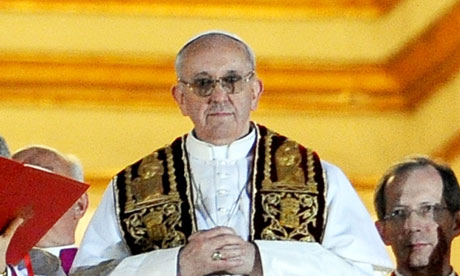
Holy Week commences. This year there's a brand new pope --the first-ever American pope ("American" in the larger sense) and the first Jesuit.
Curious, then, that he, a Jesuit, chose to take the name of the founder of the Franciscan Order. Or is it?
Right away, with regard to the poor, I thought of St. Francis of Assisi, then I thought of war. Francis loved peace and that is how the name came to me. --Pope Francis, on how he chose his papal name
With the election of Pope Francis, who vows to make the Church a "church for the poor," I'm reminded of why I love it.
In 2005, back in the dark days of the Junior Bush presidency, when the reactionaries in the US House passed HR 4437, a measure that mandated that any organization must check the immigration status of an individual before it could render social or charitable services, Cardinal Roger Mahony, Archbishop of Los Angeles, spoke out against the bill forcefully. The Cardinal announced that he would order the clergy and laity of the Archdiocese of Los Angeles to ignore the bill if it were to become law.
Cardinal Mahony quoted scripture when he wrote to Junior Bush, protesting the bill:
Subsequently, HR 4437 died an ignominious death in the US Senate. I'll always remember that act of courage and defiance by Cardinal Mahoney.In 2005, back in the dark days of the Junior Bush presidency, when the reactionaries in the US House passed HR 4437, a measure that mandated that any organization must check the immigration status of an individual before it could render social or charitable services, Cardinal Roger Mahony, Archbishop of Los Angeles, spoke out against the bill forcefully. The Cardinal announced that he would order the clergy and laity of the Archdiocese of Los Angeles to ignore the bill if it were to become law.
Cardinal Mahony quoted scripture when he wrote to Junior Bush, protesting the bill:
"Then the king will say to those on his right, 'Come, you who are blessed by my Father. Inherit the kingdom prepared for you from the foundation of the world. For I was hungry and you gave me food, I was thirsty and you gave me drink, a stranger and you welcomed me, naked and you clothed me, ill and you cared for me, in prison and you visited me."
Then the righteous will answer him and say, 'Lord, when did we see you hungry and feed you, or thirsty and give you drink? When did we see you a stranger and welcome you, or naked and clothe you? When did we see you ill or in prison, and visit you?'
And the king will say to them in reply, 'Amen. I say to you, whatever you did for one of these least brothers of mine, you did for me.'" (Matthew 25: 31-46)
And so I'm encouraged and hopeful with the election of Pope Francis. His career has shown him to be a champion of the poor, unwilling to ignore the injustice of the current global economic structure.
In 2002, he said this regarding the economic crisis that struck his homeland of Argentina: "Let's not tolerate the sad spectacle of those who no longer know how to lie and contradict themselves to hold onto their privileges, their rapaciousness, and their ill-earned wealth." Take that, neo-feudalists!
Pope Francis reportedly has resisted the comforts afforded a man of his position. He cooks his own meals and rides public transportation.
Yesterday, on his first Palm Sunday as Pope, Francis greeted the crowd in St. Peter's Square, shaking hands and dispensing blessings.
"Don't let yourselves be robbed of hope! Don't let yourselves be robbed of hope!" he exhorted to the crowd of 250,000.
A champion for the poor! Pope Francis!
Thursday, February 14, 2013
Poor old Saint Valentine
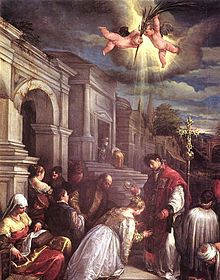
| Saint Valentine heals the blind girl |
This day is named for an historically uncertain saint, Valentine, who was martyred by the Roman Emperor Claudius II sometime around 270 ano domini.
According to one legend, Saint Valentine was a bishop of the early Christian church in the Umbria region of Italy. In that era, it wasn't easy to be a Christian. Rome hadn't yet made the conversion and Christians were generally viewed with suspicion. They were the whacky religious cult of that day (similar to today's Oprah Winfrey fans).
Valentine ran afoul of local authorities by performing certain no-nos of the time. Specifically, he provided marriage services for Christians, which was expressly forbidden by Roman law.
A local judge, Asterius, had Valentine placed under house arrest and confined to the judge's own estate. But while thus confined, Valentine continued to work on Asterius, expounding the virtues of Christianity. Asterius resisted for the most part, but in the face of Valentine's persistence, proposed a test. Asterius had an adopted daughter who was blind. He told Valentine that if he could restore the girl's sight, ostensibly through his Christian faith, Asterius would do whatever Valentine asked of him.
The girl was brought before them, Valentine did his thing and --lo and behold! --the girl could see once again. Humble Asterius then bade Valentine instruct him as to how he could become more godly. "Destroy all the false idols in your home," replied Valentine. "Then fast for three days and return to me for baptism."
Asterius did as he was directed and, upon being baptized, was reborn. He immediately ordered the release of all Christians held in his dungeons.
If Valentine had left good-enough alone, it might have ended on that happy note. But you know how those bull-headed martyrs can be, eh? He continued to preach and advocate for Christians until he eventually attracted the notice of Emperor Claudius, himself.
Valentine proved to be a bit of a smooth-talker, apparently. When he was brought before the Emperor, he managed to gain Claudius' favor despite Valentine's "crimes." Legend has it that Claudius admired Valentine and was inclined to give him a pass up until Valentine, with that galling zeal that impels all evangelists, tried to convert Claudius to Christianity. In doing so, he pushed the envelope too far. Claudius had Valentine dragged out to the Flaminian Gate where he was beaten with clubs and then beheaded.
That day, the day Valentine laid his head on the axeman's block, is known as Saint Valentine's Day.
And with that, I bid you all a happy Valentine's Day. I suggest celebrating by exchanging gifts and smooches with loved ones. Don't go out and club anybody to death, eh?
Monday, September 24, 2012
Was Jesus married? And does it even matter?
![]() |
| Unwelcome message |
A newly-identified papyrus dated from the fourth-century, roughly 150 years after Jesus (whoever or whatever he was) died, suggests that the Christian Messiah may have been married. Harvard Divinity School professor Karen L. King translates a phrase on the ancient document as "Jesus said to them, 'My wife...'" (The papyrus is torn and the phrase is incomplete.)
For most of the Christian world, the idea that Jesus was married (and therefore presumably engaged in sexual relations) is a shocker. As April DeConick, a biblical scholar at Rice University says "We have so many hundreds of years of an understanding of sexuality that in some way sex is not divine, it’s not sacred."
Forgive my cynicism, but it makes sense. Much of Christian orthodoxy requires that the Flock be convinced of its own culpability in its Fallen state. By teaching that human sexuality is dangerous and somehow unholy, believers are given proof of their inherent sinfulness, of their need for salvation (which, of course, only the church can provide).
Although Peter, the first pope, was a married man, the Catholic Church eventually dictated that its priests remain celibate. The Church's reasoning is not entirely clear, but theologian Glenn Weiser has this to say about it:
With the advent of the Dark Ages around 500, the upheavals in society saw a decline in clerical discipline and with it, a return to marriage and even the keeping of concubines by priests. During this time, the wealth of the church was also increasing, a development not lost on Rome. Many priests were leaving church lands to their heirs, and others handed down land of their own through primogeniture. The Holy See saw that a return to the celibacy rule would result in a real-estate bonanza, and in about 1018 Pope Benedict VIII put teeth in the Elvira decree by forbidding descendents of priests to inherit property. Later, in the 11th century, Pope Gregory VII, who had assumed vast power by declaring himself the supreme authority over all souls, went even further by proscribing married priests from saying mass; he also forbid parishioners from attending masses said by them. Scholars believe that the first written law forbidding the clergy to marry was finally handed down at the Second Lateran Council in 1139. --Read more here.No surprise, I suppose, that money played a part in the decision. That's the way the world works. But I digress.
What are the implications of this new revelation about Jesus and his wife? Hard to say for sure. Theologists will probably spend years pondering the matter.
But get ready for shrill accusations of blasphemy from the snake-charmers. Even today, in this (supposedly) Enlightened Age, suggesting something this radical in the wrong environment could get you tied to a fence post atop half a cord of firewood.
To my way of thinking, regardless of the accuracy and veracity of the translation, the discovery doesn't change anything. Christians, just like everybody else, adhere to a belief that is independent of factual events.
Humans create stories to provide structure and make sense of the Universe; to justify their deeply-held beliefs, regardless of the stories' provenance.
Remember how evangelical Protestants in the United States changed the 6th commandment to say "Thou shalt not murder?" The old commandment "Thou shalt not kill" didn't jibe with their war-lust.
My prediction is that most organized Christian churches will attempt to discredit the discovery. Failing that, they'll ignore it. There's just too much invested in the idea of a celibate Jesus. Entire belief structures hinge on it.
That's not all there is to say about the controversial papyrus. Another translated phrase throws a monkey wrench into the established orthodoxy. It's this: "[my wife] will be able to be my disciple."
But that's another ball of wax entirely!
Sunday, April 08, 2012
Agnostic query on Easter Sunday
There are very few areas in the vast, mind-boggling expanse of the Christian creed upon which its billions of adherents have attained enough agreement to achieve any kind of coherence. Easter celebration, the discovery of an empty tomb in Golgotha, is one such, however. Christians choose this day, arrived at through an archaic calculation involving the first Sunday following the full moon that occurs after the year's vernal equinox*, to celebrate the day that Jesus rose from the dead, revealing Himself as the Christ.
It's a fascinating and wondrous story with moral and spiritual meaning worthy of a lifetime of examination. What is the significance of Christ's death and resurrection? As Judas Iscariot asks in the 70s rock opera, Jesus Christ Superstar, "Who are you? What have you sacrificed?"
Seeking the answers to those questions is fascinating and rewarding.
But, in order to be Christian, one must believe in the literal truth of the story. One must believe that the broken and tortured body of Jesus was restored and reanimated and walked again among the living before ascending to Heaven. In fact. Actually. To be Christian, one must believe that, had you been there, you would have seen the healed wounds, might have witnessed Jesus being lifted from the Earth. For yourself. With your own eyes.
In other words, in order to be a Christian, one must believe something which is counter to everything we perceive in the world around us.
Why?
The Gospels tell us that Jesus, Himself, revealed His wisdom in the form of parables. He told stories that conveyed lessons for those who would learn them. The literal truth of the parables was not important. What was important was the wisdom, the Truth, that the parables revealed.
So, why is the Resurrection story different? If one spends one's life pondering the story of Jesus' death and resurrection, examining it for meaning in one's daily life, striving to see how it reveals truths that might be otherwise unattainable, why does the literal truth of the story even matter? The same holds for the Virgin Birth, and for Jonah and the Whale, and for Noah and the Great Flood.
Respectfully, Christians, I have to ask: Why must the story be literally true? What difference does it make?
*The tie to the equinox is a dead-giveaway that the early Christians supplanted the Pagan vernal celebration with Easter as a way to facilitate conversion, ce n'est pas?
Monday, December 12, 2011
Courageous Christianity
| Maybe He was on to something... |
I keep going back to that moment. The moment when Robert Rule, a bereaved father, broke Gary Ridgway, the Green River Killer, the murderer of Mr. Rule's daughter. (Video here.)
Robert Rule's act is one of the most courageous displays of Christianity I have ever witnessed. Humbling and and terrifying and beautiful.
Humbling, because I've never had occasion to show the kind of courage that Mr. Rule showed. I don't know that I could muster it.
Terrifying, because --well, because, Lord! How could You have done that to this man?
And beautiful, because it shows us, plain as Day, that we are none of us beyond Redemption.
Paraphrasing the good Professor, while evil is evil, it may yet also be good-to-have-been.
Christmas approaches.
Thursday, August 04, 2011
Young Christians in Tabor
![]() |
| Western Seminary basks in the sunset |
A young man, a bit older than the rest, stood in their midst, speaking. I listened as I passed through.
"... it's about who you follow," he said. He held his hands before him, palms to the fading sky. He spoke earnestly. He spoke honestly. To the west, the sun painted the horizon pink. "If you choose to follow Jesus, you become part of a family," he said. "You're automatically just as important as anyone else."
I found it impossible not to like the kids. All of them. Who can resist the innocence and oblivious beauty of youth? Especially youth motivated by the desire to do good, to be good, to contribute to society in a positive way?
But, of course, being the angst-ridden hair-splitter that I am, I was troubled by the young man's statement.
Not the bit about being part of a family when you follow Christ. That is one of the aspects of religion that I admire most: the way that it encourages and promotes community, the way that it brings people together, the way it encourages a morality that, frankly, elevates us above brute existence.
But the youth's second sentence: "[If you are Christian] you're automatically just as important as anyone else." I found that troubling.
Why? Because there is an implication that, if you are not Christian, you may not be as important as anyone else. Or, putting it another way: The only way to be sure you are as important as anyone else is to be a Christian.
As the husband of a devout Muslim, of course, this is going to chafe. But, to the extent that I understand Christian dogma, isn't it contradictory? After all, didn't Christ say: “Love the Lord your God with all your passion and prayer and intelligence. Love others as well as you love yourself”?
Or this: "Anyone who claims to be in the light but hates his brother is still in the darkness. Whoever loves his brother lives in the light, and there is nothing in him to make him stumble"?
Or this: "A new command I give you: Love one another. As I have loved you, so you must love one another"?
That well-intentioned young man on the path in Mount Tabor, I am sure, had no inkling of the un-Christ-like implications of the second part of his statement. A glance at his sincere expression revealed as much.
But, if I could have done so without intruding, I might have said to him: "Son, no one is any more important than anyone else. I can't say I'm a Christian, but I've always believed that. And, you know, I think that may be what Christ preached."
N'est-ce pas?
Saturday, March 26, 2011
La Luz pronuncia las Escrituras
Yo estaba andando por el bulevar de Martin Luther King, Jr. esta tarde, y encontré un edificio llamada La Luz del Mundo. En las paredes de la iglesia, yo leà que IsaÃas nos pide "¿Quien ha creÃdo nuestro anuncio? y a quien se ha revelado el brazo del Señor?"
Como se proclama en la Iglesia de la Luz del Mundo, los efesios proporcionan la respuesta: "Edificados sobre el fundamento de los apóstoles y los profetas, siendo Cristo Jesús mismo la piedra angular."
Mientras tantos, en el cielo, las nubes estuvieron en guerra, pero la luz estuvo más allá. Más allá de las nubes y más allá de comprensión. Nunca podemos comprenderla. Pero, es bueno a tratar. Debemos continuar probar.
Monday, April 26, 2010
Questions for Catholics
![]() |
| St. Stephens Catholic Church |
Yesterday, I attended Mass at St. Stephen's Catholic Church, up on SE 41st and Taylor, with my sister, Chae. (This is a year of great faith for me, apparently, seeing as I have now attended Mass twice in one year!) The priest is a man of Asian descent, Father Petrus. His sermon included two anecdotes, one humorous and one exemplary, both of which I enjoyed. He and the deacon were friendly and welcoming.
This was the first Mass I have attended at St. Stephen's church. Mostly, I attend the St. Philip-Neri Catholic Church down on Division Street (when I attend at all). The congregation at St. Stephen was older and not nearly as numerous as that of St. Philip-Neri. The church itself was spectacular, with its stained glass windows depicting various biblical scenes, and its vividly-sculpted (but not overly gruesome) Stations of the Cross.
In truth, although I am not a member of the Church, never having been baptized, I long to be a part of it. I find the ritual and tradition associated with the Church to be beautiful. I believe the Church can serve (has, in fact, served) as a vehicle to improve the lot of humanity. I yearn for a way to express the brotherhood I feel and the love I have (or wish to have, anyway) toward mankind. And, then, there is that my father, on his death bed, expressed his wish that I be baptized.
During the Mass, one of the congregation, a tiny, prim, elderly woman with her head bent down between her shoulders, and her chin only just reaching the top of the lectern, led us in a prayer for the priests of the Church. Of course, that got me to thinking...
The Catholic Church is currently enduring some (much-deserved) criticism. Over the years, for the last several decades, pedophiles have penetrated the priesthood and have sexually abused children within the Catholic flock. But, of course, pedophiles are everywhere in our society and there is no reason to expect that they would not be in the Catholic clergy any less than anywhere else. The issue that Catholics and others find most egregious is that there seems to have been a cover-up of this activity by the Church hierarchy, extending all the way up to the Vatican. Indeed, even the Holy Father is implicated in the cover-up.
The scandal is grievous. But there is no question that the Church will survive it. After all, the Catholic Church is the largest single institution in all of humanity, as measured by the number of people that claim membership. The Church has been shaped by some of the greatest minds that mankind has produced: Thomas Aquinas, Michelangelo, Pope John Paul II, and many others.
On the other hand, the Catholic Church is guilty of egregious sins. The pedophilia cover-up is not even the worst. How about the Inquisition? How about the slaughter and enslavement of indigenous Americans? Or how about the systematic murder of pagans in the early days?
Further, I am uncomfortable with many aspects of the Catholic creed.
I am uneasy with the concept of so much power resting in the hands of a single man (the Pope). As today's headlines so often remind us, any man can fall. Check that --rather, every man will fall. And the process by which a pope is selected is highly-political, which will make wary any but the most blind of zealots. So, why should so many people ever accept as "infallible" the words of a man, any man, who is capable of sin and who has attained his position as leader of the Church through political maneuvering?
Then also, I have doubts about my own motives. I can't say that I believe in the Virgin Birth, nor that Christ died for my sins, nor that He was anymore the Son of God than anyone else. Can I truly be a Catholic without believing these things? Must I will myself to believe them before I become baptized? And, if so, how do I do that? Do I simply accept them as true? I'm not sure that is within my ability.
I've appealed to the clergy for help with these questions, but the priest seemed impatient with my queries. (I don't blame him. Priests have a lot of demands on their time.) So, this time, I thought I'd appeal to the laity. Are there any Catholics out there who have wrestled with similar questions? How did you deal with them? How do you reconcile your misgivings and your doubts?
In all sincerity, I'm asking.
Monday, March 29, 2010
What did you mean, Judas Iscariot?
![]() |
| Judas and the Magdalene |
Holy Week, as the Christian's term it. And once again my thoughts turn to the last week in the life of Jesus of Nazareth, recognized by over a billion souls as the Messiah, humanity's Redeemer.
Judas, of course, is mostly remembered as one of the Twelve Apostles of Jesus. According to the gospel of Mark, Judas was the group's money man, keeping track of finances, controlling the purse strings. When the call came down to have Jesus arrested, Judas betrayed Him to the Roman authorities, identifying Jesus with a kiss (the Judas Kiss). For this service, Judas was allegedly paid the tidy sum of 30 pieces of silver. Jesus was subsequently crucified.
My fascination with Judas goes to motive. What did he hope to gain with his betrayal?
Scholars have postulated several theories: One is that Judas had a weakness for money and was motivated by the bounty paid out by the Pharisees. But surely Judas must have been driven by something more than a paltry 30 silver pieces, no? Such a sum seems pretty insignificant when weighed against an eternity of torment. Or is it possible that Judas acted out of ignorance? That he did not, in fact, believe that Jesus was the Messiah? And, if that is the case, is Judas less culpable?
Another possible motive is that Judas felt betrayed by Jesus, whom he expected to overthrow Roman rule of Israel. In this view, Judas is a disillusioned disciple betraying Jesus not because he loved money, but because he loved his country. Some people might construe this as a noble motive.
Or there is the supernatural theory: According to Luke 22:3-6 and John 13:27, Satan entered into Judas and called him to do it. In that case, it seems grossly unfair to hold Judas guilty of anything. He was compelled to betray Jesus, perhaps against his will.
![]() |
| "Come 'ere, gimme kiss." |
But, taking the larger view for a moment, regardless of his motive, did Judas not act according to God's will? After all, in order for the prophesy to be complete, someone had to betray Jesus. So, was Judas not merely fulfilling the role that God had written for him? (Martin Scorcese's difficult but rewarding film "The Last Temptation of Christ" espouses this particular theory.) This theory strikes at the age old and never-ending debate around Free Will and Predestination. That debate has been going on since long before Jesus of Nazareth ever got dunked in the Jordan River. It'll still be going a thousand years hence.
But that, it seems to me, flies in the face of the concept of an all-forgiving God. And did not Christ Himself (purportedly) exclaim as He died on the cross: "Father, forgive them, for they know not what they do"? (Whatever happened to "Not perfect, just forgiven?")
Well, after all these centuries of theory and counter-theory I have faith (heh) that the questions around Judas Iscariot will never be answered to my satisfaction. And besides, as I've stated many times before, it is futile to look for literal meanings from scripture. Rather, scripture is presented to us so that we can ponder it, ruminate on it, theorize about it. I don't believe that it offers the concrete, black-and-white answers that fundamentalists (of any stripe) favor. And, it's Holy Week, so what the hell? (No pun intended.)
Carl Anderson (aided by lyricist Timothy Rice) did a brilliant interpretation of Judas Iscariot in Jesus Christ Superstar. Here's the opening tune of that flick, Heaven on Their Minds.
Friday, December 11, 2009
Hope it ain't so
Old Man Fenton squinted up at the Preacher from the corner of his one good eye. His left eye was cloudy and blue and he couldn't make anything out with it, but his right eye was marble black and sharp as a hawk's. He craned his head forward from hunched shoulders. Although a few pale brown strands were combed back across his otherwise bald crown, most of his hair (which wasn't much, anyway) clung to his temples and around his ears. He leaned across the barren table toward the Preacher, his face cocked to one side.
The Preacher, beaming with the bright eyed expectation of a miracle, waited for the questions to come. He had been working toward this moment for a long time.
Old Man Fenton spent a good long time squinting, first at the Preacher, then at the barren tabletop between them. Then he spoke. "So, you're telling me that Jesus come down from Heaven 'cause He loved us and He wanted to save us?"
"Yes, that's right," said the Preacher. He was exhausted, mentally and physically. But he was also exhilarated, poised to win a victory for the Lord.
"And they still done Him like they did?" Old Man Fenton inquired. "Knifed Him and lynched Him like that?"
"Yes, that's the way of it," said the Preacher. All glory is for Thee, Lord. All glory for Thee.
"Hmm..." Old Man Fenton mused. His brow was drawn together, a furrowed row over his eyes. He seemed deep in thought.
After a long moment, he shook his head with a sadness that puzzled the Preacher. "Well," said the old man, finally, "I suppose about all we can do... is hope it ain't so."
Thanks to Charles Frazier for the inspiration.
Friday, April 10, 2009
Anniversary of a 2000-year-old lynching

Today is Good Friday; the nominal anniversary of the Crucifixion of Christ some 1,976 years ago. Although no one knows for certain, Biblical scholars speculate that the crucifixion occurred on a Friday based on details of the Sanhedrin Trial of Jesus. The time of year has never been firmly established, as far as I know. Some suspect that the Catholic Church chose springtime so as to make the Easter holiday roughly coincide with the Pagan celebration of the Spring Equinox. The Church, after all, was trying to convert a skeptical bunch of druids and oak-tree huggers.
Be all that as it may, let's not spend time arguing about the specifics, eh? Let's just roll with the idea that today, Good Friday, is the anniversary. So, today was the day that the Roman guards dragged poor Jesus out of his dungeon and nailed him up. It was the end of a bad week.
On the previous Sunday, Palm Sunday, Jesus, his twelve apostles, and their entourage rode into Jerusalem so Jesus could get a wider audience for his message. Today's equivalent, I suppose, would be to land a gig on Letterman or Leno. Jesus' message was a simple message which I hesitate to characterize. Let's go with this: God is accessible to everyone. No need for intermediaries and arcane rituals. He is there; He can speak to us all.
But to the Jewish powers-that-were, the Pharisees and Priests of the Jewish orthodoxy, Jesus was an uneducated hillbilly, a mob orator come down from the hills to stir up trouble. He claimed that they were hypocrites, more interested in promoting their own agendas than serving their people or their God. He lambasted them, riled up the common folk against them, scorned them publicly.
The Romans, for their part, had no dog in the fight. It was all one to them. Let the Jews sacrifice goats on altars, burn incense, and mumble their incantations. Or, if that wasn't what they wanted, throw it all away and follow this charismatic upstart from out in the sticks. So long as everybody continued to "render unto Caesar" there wouldn't be a problem.
Well, the Jewish mucky-mucks decided that Jesus was getting too big for his britches. So, they secretly approached one of Jesus' inner circle, Judas Iscariot, and cut a deal. They bribed him to lead them to the place where Jesus and the gang were hanging out on Thursday night: barbecuing, drinking a little wine. There, they arrested him on some trumped up charges and dragged him before the Roman governor, Pontius Pilate.
Pilate, however, didn't want to get involved in the brouhaha and refused to render judgment, deferring to the Jewish king of Galilee. So they took the shackled Jesus away to Herod's place where he endured a quick (and no doubt, "fair") trial which was wrapped up in short order. Guilty as charged.
Back to Pilate, who began to sense that the Jews had their blood-lust up and didn't want to stand in the way, possibly instigating riots. Wouldn't look good in the reports back to Rome. Reluctantly, he authorized the execution.
The next day was Friday... what is today called Good Friday...
When it was all over, they took down the broken corpse and stowed it away. On Sunday, Easter Sunday, Mary Magdalene, one of Jesus' entourage, went to prepare the body for entombment and had a bit of a shock...

So, that, in a very rough nutshell, is what happened on that week one-thousand nine-hundred seventy-six years ago, according to Christian tradition. Whatever the literal truth, that series of events caused titanic movements in the sea of humanity.
The Christians claim that Jesus was "the Christ;" the Jews claim he was an impostor; the Muslims split the difference, claiming he was a high, holy prophet, but not the son of God.
I don't claim to know. As I've stated before, the literal truth of the story is, for me, not so important as the moral lessons that are derived from it. And so, I'll sign off today with some of the words Jesus was alleged to have spoken as he died.
- “My God, my God, why have you forsaken me?” --Matthew 27:46
- “Father, forgive them, for they do not know what they are doing” --Luke 23:34
- “Father, into Your hands I commit my spirit” --Luke 23:46
- "It is accomplished" --John 19:30
Tuesday, February 17, 2009
Puritan values keeping us in the Dark Ages
So many of the backward social mores that hinder and torment this nation are the endowment left us by those 200 or so prudes that washed up on the shores of this continent back in 1620. You know? The Pilgrims? That little group of Calvinists that were so god-awful prude that even the puckered-ass Church of England couldn't stand them?
These folks were so uptight, with their insistence that human beings must at all times strive to live in accordance with the Bible down to the smallest details of their lives, with their belief that human beings were inherently sinful and loathsome, that no one else could even tolerate their company.
So they set off for America with their buckles on their ridiculous hats, clutching their Bibles and maintaining an insane vigilance against the Devil. These people were so repressed, so burdened with guilt that they were dangerous. They regularly sought for and found the Devil in their midst. Those whom they accused, their own neighbors and family, they cruelly tortured and put to death: drowning, hanging, burning at stake.
Imagine a pretty, young girl, unaware even of her own prettiness who, while on a visit to the market, makes the mistake of smiling at some twisted and repressed village elder. The elder, feverish and tormented in his fight against his own sexual urges, his "sin," cannot rid his mind of the image of the pretty girl and her smile. He is driven mad by lust. He therefore concludes that the poor girl has cast a spell on him, that she is a witch. Well, you know where it goes from there...
Times have changed somewhat, thankfully. The so-called founding fathers of the United States recognized the tyranny that might be imposed by religion and crafted the Constitution as a safeguard against it. One of my favorite quotations on the matter comes from Thomas Paine:
But, of course, puritanism is still with us. Today's inheritors of the puritan morality are the Christian evangelicals that routinely retard social progress. Here are just two examples:
Well, people, we're stuck with them. They're not going away. Our only consolation is that, no matter how much they annoy us, they are themselves miserable; it's their nature. They resent people that don't live as they do, especially when they don't see those people suffering as a result of their "sin." I heard a definition once that I thought nailed it perfectly:
Puritanism: the vague fear that someone, somewhere might actually be happy.
These folks were so uptight, with their insistence that human beings must at all times strive to live in accordance with the Bible down to the smallest details of their lives, with their belief that human beings were inherently sinful and loathsome, that no one else could even tolerate their company.
So they set off for America with their buckles on their ridiculous hats, clutching their Bibles and maintaining an insane vigilance against the Devil. These people were so repressed, so burdened with guilt that they were dangerous. They regularly sought for and found the Devil in their midst. Those whom they accused, their own neighbors and family, they cruelly tortured and put to death: drowning, hanging, burning at stake.
Imagine a pretty, young girl, unaware even of her own prettiness who, while on a visit to the market, makes the mistake of smiling at some twisted and repressed village elder. The elder, feverish and tormented in his fight against his own sexual urges, his "sin," cannot rid his mind of the image of the pretty girl and her smile. He is driven mad by lust. He therefore concludes that the poor girl has cast a spell on him, that she is a witch. Well, you know where it goes from there...
Times have changed somewhat, thankfully. The so-called founding fathers of the United States recognized the tyranny that might be imposed by religion and crafted the Constitution as a safeguard against it. One of my favorite quotations on the matter comes from Thomas Paine:
"Whenever we read the obscene stories, the voluptuous debaucheries, the cruel and torturous executions, the unrelenting vindictiveness, with which more than half the Bible is filled, it would be more consistent that we called it the word of a demon, than the word of God. It is a history of wickedness, that has served to corrupt and brutalize mankind." - Thomas Paine (The Age of Reason, 1794-1795.)There are many more similar quotations here.
But, of course, puritanism is still with us. Today's inheritors of the puritan morality are the Christian evangelicals that routinely retard social progress. Here are just two examples:
- In 2007, the Food and Drug Administration approved a vaccine, Gardasil, that protects against the Human Papillomavirus (HPV), a sexually-transmitted disease that is known to cause cervical cancer in some women. HPV is so common that physicians recommended that girls as young as 9 years old be given the vaccine, presumably in an attempt to protect them before they become sexually active. But rather than express relief that modern medicine may have actually achieved a significant breakthrough in defeating cervical cancer, evangelical Christians shrieked that administering the vaccine would encourage promiscuity.
- Despite many studies that show that sex education is effective in reducing teen pregnancies and the transmission of STDs, evangelical Christians, under the wise guidance of Junior Bush, prohibited federal dollars from being expended on anything other than "abstinence-only" sex education. That is, education that teaches only that abstinence is the "only certain way" to avoid pregnancy and STDs and that the expected standard of human sexual activity is "a monogamous relationship within the context of marriage." Apparently, if kids were armed with real knowledge they would be unable to resist the temptation to f*ck their brains out.
Well, people, we're stuck with them. They're not going away. Our only consolation is that, no matter how much they annoy us, they are themselves miserable; it's their nature. They resent people that don't live as they do, especially when they don't see those people suffering as a result of their "sin." I heard a definition once that I thought nailed it perfectly:
Puritanism: the vague fear that someone, somewhere might actually be happy.
Friday, February 13, 2009
Faux Christian masochism: Waiting for the day

Once again I don my Doomsday hat, postulating that our civilization, our species, is fast approaching some cataclysmic crescendo that will usher in a new historical movement, some change in tempo or key that will mark a new age. None can know exactly when or how this transition will occur, nor indeed what to expect on the other side. But if one has been paying any attention at all to current events, to the exponential growth of human population, to the depletion of the resources that fuel our civilization, to the irreversible changes occurring in our environment, it seems inevitable that compulsory change is coming for humanity.
And while I believe that many human institutions, including organized religion, can help humanity in the trying times to come, I also know that there are those who will revel in the insanity and fear that the recognition of such a transition will engender, who will delight in and promote chaos and lunacy. (Picture a mad sailor, in the crow's nest of a flaming frigate, laughing and swilling rum from a jug, even as the flames climb the mast and rigging to claim him.)
One such group of apostates is the sect (for lack of a better word) of faux Christians that work from the mindset that they are oppressed, tortured souls, saintly in their virtue and forgiveness, eagerly awaiting Judgment Day when their god will set everything to right. Chris Hedges wrote about this movement in his book, American Fascists: The Christian Right and the War on America.
I remember when Mel Gibson's flick, the Passion of the Christ, came out back in 2004. I spoke with several professed Christians who were deeply moved by the film, which depicts the Christ character being tortured mercilessly for more or less its entire run time. By all accounts the film is graphic and difficult to watch. But there seemed to be a common current among the sentiments expressed by those who admired the film: gratitude toward Christ. I remember a television report that showed people leaving the cinema in tears, wailing "He did it for me!"
(In the interest of full disclosure, I have not actually seen the flick. My opinions regarding the film are based on what I have read about it and what I have heard from others. And I have seen other of Gibson's flicks (Braveheart, Lethal Weapon) where the protagonist "virtuously" endures torture.)
Well, the mindset that Gibson reveals with his work is, to me, exemplary of this lunatic faction of so-called Christians. I find it sick that people would enjoy what sounds to me like an elaborate snuff flick. The masochistic idea that it is virtuous to endure torment and suffering twists at my guts, fills me with distaste and revulsion.
But what is even more frightening is the thought that these people, these martyrs for their god, are impatiently awaiting the final Trumpet Call, when they will mete out the vengeance that is their due upon those whom they imagine as their oppressors. Already, we see signs that they believe we are approaching the Day of Judgment.
In July, I wrote about the horrible shooting that occurred in Powell, Tennessee, where a demented conservative, Jim D. Adkisson opened fire in a Unitarian Universalist Church. Well, recently, the authorities released the hand-written letter that Adkisson penned as a suicide note and manifesto. Here's some choice quotes:
Don't let the word church mislead you. This isnt a church, it's a cult. They don't even believe in God. They worship the God of Secularizm. [...]You can read the whole thing here.
So I thought I'd do something good for this Country. Kill Democrats til the cops kill me. If decent patriotic Americans could vote 3 times in every election we couldn't stem this tide of liberalism that's destroying America. Liberals are a pest like termites. Millions of them. Each little bite contributes to the downfall of this great Nation. The only way we can rid ourselves of this evil is Kill them in the streets. Kill them where they gather.
I'd like to encourage other like minded people to do what I've done. If life aint worth living anymore don't just Kill yourself, do something for your country before you go. Go Kill Liberals.
Tell the cop that killed me that I said "Thanks, I needed that!" -Jim Adkisson
Note the tone of suffering, the vehemence. Adkisson, who survived the incident, sees himself as a victim. A virtuous Christian patriot who endured the slings and arrows cast at him by liberals. But, in what he thought would be his final act, he sought to bring about Judgment Day, to light the fire that will consume the world, calling for "like minded people to do what I've done."
As I said at the beginning of this post, humanity is facing a painful, frightening transition. The last thing we need is a sect of aggrieved fanatics chomping at the bit for payback.
Thursday, August 21, 2008
Burnin' Lake of Fire

Once more delving into the Mahatma Candy archives, I give you Burnin' Lake of Fire. This tune, which we always introduced as the "musical Cliff Notes for John Milton's Paradise Lost," is sung to the tune of the great Johnny Cash's Ring of Fire.
I was born into the Light,
A servant of Heaven's Might;
I sat at God's right hand,
Until He chose the Son of Man;
He cast me down to a burnin' lake of fire,
I fell down, down, down and the flames went higher
And it burns, burns burns, the lake of fire,
The lake of fire;
My angels and I took to flight,
To prepare for the awful fight;
His chariot in flames was veiled;
And, oh, down we fell;
He cast me down to a burnin' lake of fire,
I fell down, down, down and the flames went higher
And it burns, burns, burns, the lake of fire,
The lake of fire;
Our cause has come to grief;
From torment's flames there's no relief;
But hope I won't forsake;
I've got one more card to play as a talking snake!
He cast me down to a burnin' lake of fire,
I fell down, down, down and the flames went higher
And it burns, burns, burns, the lake of fire,
The lake of fire;
Wednesday, August 20, 2008
Neo-conservative Christianity: It's okay to kill
Back in the dark days of 2002, when Junior was beating his Iraq war drum like a new Christmas toy, I became engaged in many heated conversations with benighted Bush supporters who felt that the invasion was morally justified and imperative to the security of the United States.
Never mind that the case being made by the administration was so full of holes that it made St. Sebastian's carcass look like a finely woven Kashmir carpet.
Some of the most vociferous of the war advocates professed to be "Christian," of course. They trusted that Junior was a "good man." They believed he was restoring "dignity" and "integrity" to the Oval Office. (One has to hope that nowadays, as the depth of the moral morass in which we find ourselves is revealed, these same people are just a tiny bit chastened. But probably, they are not.)
It has always puzzled me how supposed Christians can advocate war, but this was especially true in 2002, when I put forth the argument that "Your Bible commands that 'Thou shalt not kill.'"
Well, wouldn't you know it? "Christian" scholars have now "discovered" that the commandment "Thou shalt not kill," is actually a mistranslation. The "correct" interpretation of the original Hebrew (or is it Greek?) is "Thou shalt not murder." So, war is okay with Christ. Just don't "murder" anyone. (You can read all about this reinterpretation here.)
What about these Bible passages, Christians? How shall we interpret these? And how do they jibe with your justification for war?
One can hear these fake Christians, even now, saying "Hold on. Not so fast. Let's not go too far. We just wanted to feel good about our war, that's all."
Anyone who speaks more than one language can tell you that precise translation is nigh on impossible. That's true for modern, living languages and one has to assume that it is even more true when applied to the translation of ancient "dead" languages. But "Christians" don't want to know all that. It's better to just follow the leader and keep one's eyes shut tight.
Well, "Christians," I've got another ancient myth you should check into before you next go off and use fallacious logic to justify your hypocrisy. It's commonly referred to as Pandora's Box.
Never mind that the case being made by the administration was so full of holes that it made St. Sebastian's carcass look like a finely woven Kashmir carpet.
Some of the most vociferous of the war advocates professed to be "Christian," of course. They trusted that Junior was a "good man." They believed he was restoring "dignity" and "integrity" to the Oval Office. (One has to hope that nowadays, as the depth of the moral morass in which we find ourselves is revealed, these same people are just a tiny bit chastened. But probably, they are not.)
It has always puzzled me how supposed Christians can advocate war, but this was especially true in 2002, when I put forth the argument that "Your Bible commands that 'Thou shalt not kill.'"
Well, wouldn't you know it? "Christian" scholars have now "discovered" that the commandment "Thou shalt not kill," is actually a mistranslation. The "correct" interpretation of the original Hebrew (or is it Greek?) is "Thou shalt not murder." So, war is okay with Christ. Just don't "murder" anyone. (You can read all about this reinterpretation here.)
What about these Bible passages, Christians? How shall we interpret these? And how do they jibe with your justification for war?
You have heard that it was said, 'An eye for an eye and a tooth for a tooth.' But I say to you, Do not resist one who is evil. But if any one strikes you on the right cheek, turn to him the other also; and if any one would sue you and take your coat, let him have your cloak as well; and if any one forces you to go one mile, go with him two miles. Give to him who begs from you, and do not refuse him who would borrow from you. You have heard that it was said, 'You shall love your neighbor and hate your enemy.' But I say to you, Love your enemies and pray for those who persecute you, so that you may be sons of your Father who is in heaven; for He makes His sun rise on the evil and on the good, and sends rain on the just and on the unjust. (Matthew 5:38:45 RSV)Regardless of the pseudo-scholarly arguments that are used, this relatively recent discovery about the translation of the Sixth commandment seems somewhat convenient, no? Does this mean that all these hundreds of years since the invention of the printing press, the Christian holy book has been in error? And, if this translation was incorrect, dare we suspect that there may be other translation errors in today's Bible? In fact, does this not call all Biblical teaching into question?
Blessed are the peacemakers, for they will be called sons of God. (Matthew 5:9)
One can hear these fake Christians, even now, saying "Hold on. Not so fast. Let's not go too far. We just wanted to feel good about our war, that's all."
Anyone who speaks more than one language can tell you that precise translation is nigh on impossible. That's true for modern, living languages and one has to assume that it is even more true when applied to the translation of ancient "dead" languages. But "Christians" don't want to know all that. It's better to just follow the leader and keep one's eyes shut tight.
Well, "Christians," I've got another ancient myth you should check into before you next go off and use fallacious logic to justify your hypocrisy. It's commonly referred to as Pandora's Box.
![]() |
| Oops! |
(Full disclosure: This post was inspired by Hopeful Muser's thoughtful post, Ignorance.)
Wednesday, August 08, 2007
Christians vs. "Christians"
![]() |
| An Amish church |
One of the most offensive aspects of Evangelical Christianity, as it is practiced in the United States, is the propensity of some of its leaders to advocate war and hatred. Consider these gems:
- But you've got to kill the terrorists before the killing stops. And I'm for the president to chase them all over the world. If it takes 10 years, blow them all away in the name of the Lord. - Jerry Falwell, decomposing corpse, in November, 2004. Read the entire article here.
- There will never be world peace until God's house and God's people are given their rightful place of leadership at the top of the world. - Pat Robertson, demagogue, in his book New World Order.
- In my heart, yes, through God's help. - Enos Miller, grandfather of two of the victims, when asked if he had forgiven the killer.
- We're really strongly taught to forgive like Jesus did. We forgive the way Christ forgives us. - Katie Weaver, an Amish woman connected to the Pennsylvania community
- If someone strikes you on the right cheek, turn to him the other also. - Matthew 5:39
- Blessed are the merciful: for they shall obtain mercy. - Matthew 5:7
- Blessed are the peacemakers: for they shall be called the children of God. - Matthew 5:9
- But I tell you, Love your enemies, bless those who curse you, do good to those who hate you, and pray for those who revile you, and persecute you; - Matthew 5:44
Evangelical "Christians" however, seem to revel in material wealth. They worship in megachurches; they drive big, gas-guzzling SUVs; they shake their fists at the terrorists and rationalize the injustices done in the name of their "freedom." Love thy neighbor? Not in this lifetime!
![]() |
| A Christian megachurch |
Of course, hypocrisy is nothing new to right-wing Evangelicals, as we have learned, time and again through such teachers as Jim Bakker, Jimmy Swaggart, and most-recently, Ted Haggard. Sinclair Lewis wrote brilliantly about it in his horrifying 1927 classic, Elmer Gantry. When it comes to glitch, wealth, and especially power, the bigger the better, as far as these "Christians" are concerned.
Evangelical Christians will continually fall in line behind any charlatan that mouths pious validation of their pre-existing prejudices and bigotry, whether it be homophobia, Islamophobia, or moral ambiguity. (Note that it is largely white evangelical males that continue to support Junior Bush, even as the public at large has finally caught on to him.)The pathos is palpable. In their perpetual misery, desperate people, frightened by the world around them, cling to their material belongings as the only measure of their worth. They look to cynical leaders to protect them, to validate them, to assure them that they are pious and righteous.
It's not that deep in their hearts they don't know better. It's that they're cowards. It's that they don't have the guts to give what Christ was asking:
Do not Lay up treasures for yourselves on earth, where moth and rust corrupt, and where thieves break in and steal:
But lay up for yourselves treasures in heaven, where neither moth nor rust corrupts, and where thieves do not break in nor steal:
For where your treasure is, there will your heart be also. - Matthew 6:20-21
No man can serve two masters: for either he will hate the one, and love the other; or else he will hold to the one, and despise the other. You cannot serve God and mammon. - Matthew 6:24
So likewise, whosoever he be of you that forsaketh not all that he hath, he cannot be my disciple. - Luke 14:33
Again I say to you, it is easier for a camel to go through the eye of a needle, than for a rich man to enter the kingdom of God. - Matthew 19:24
Subscribe to:
Posts (Atom)