Monday, July 12, 2010

OCF 2010: Headlong into the bureaucracy (Pt. I)

Another tomorrow in the brief dusty march completed.  A sojourn through the hippie duality of hedonism and social awareness:  Oregon Country Fair, 2010.


Ed Knoph, a potential sorcerer and a friend of several years, came by the house on Tuesday night, and we loaded up my little errand-running city car so that we could get an early start on Wednesday morning.  This year, my fifth (non-consecutive) year as "official" Fair Staff, I was granted:
  • an Outta Site parking permit which meant that I could drive my car this year (a first);

  • a Significant Other Pass (S.O.P.)!  An S.O.P. is a plum.  It means that one is not recognized by Fair bureaucracy as working staff, but rather as the life partner of a working member of staff.  According to the law of the Fair as written, S.O.P.s are not required to work unless they so desire.
Ed and I were on the road out of Portland by 9am.  Leaving at that relatively early hour, we were afforded a leisurely pace, which is good.  The logistics of the Oregon Country Fair necessitate an enormous organizational structure.  The system seems to operate on the very brink of anarchy and collapse at all times.  So, it is good to approach the entrance to the labyrinth with as much saintly resignation as one can muster.  There will certainly be hassles. But, believe it or not, the system somehow works.  (Perhaps that's true of all bureaucracies.  I don't know...) 

Fair Admissions
Ed and I arrived at Fair Admissions sometime around noon.  Our names were located on the appropriate lists so that we could be awarded our identification bracelets.  One hurdle out of the way!

Next, we queued up for our parking permit.  Since it was still early, our wait was not long.

When we got to registration table, we were met by the old country hippie in charge of issuing parking permits.  A nice enough fellow.  By the lines on his face, I judged him to be in his late 50s.  He had a railroad cap on his head; his mostly-white-with-a-tinge-of-rusty-brown hair was pulled back in a pony tail.  He wore John Lennon wire-frames on the bridge of his bulbous nose.  His skin was a pinkish-red "farmer's tan."  He informed me that since I was designated an S.O.P., I was ineligible for a parking permit.

"Maybe the permit is listed in Ed's name" I said, hopefully.

He looked through the file again.  "Yeah, here it is," he said after a minute.  "Ed Knoph.  See the 'OS' by his name?  That means he's got an Outta Site pass."

"But wait!" said another bureaucrat, pointing at a different list.  "Look here!  According to this list, Ed Knoph has the initials 'FS.'  He's part of Far Side camp and doesn't get a permit."

Bureaucratic snafu!  The lists did not match!  We had arrived at a dead-end in the maze. 

All present were stymied.  Someone suggested that I call my crew leader.  Which I did.  But Mark didn't pick up.  I left a voice message on his cell.

Lost in the system
 Ed and I decided to unpack our camping chairs and take a seat in the shade of some nearby trees to await word from Mark. We sat and watched Fair Folk arriving in their hundreds.

My cell phone rang.  It was Mark.  "Hang tight," said he.  "I've been detained at work, but I'll be there as soon as I can."  (Mark lives and works in nearby Florence.)  Ed and I were reassured.  Mark Freeman is an expert at negotiating the Fair bureaucracy

It was roasting hot, and dusty, and muggy, but I was content enough, sitting in the shade.  People passed by, friendly and happy.  The Fair does that to them.

Oso came by, at one point.  Oso is a gruff, grizzly hippie, at least six and a half feet tall, shaped like a mountain.  He's got waist-length white hair.  He usually wears coveralls, with no shirt underneath.  He is a Very Important Person in the Fair hierarchy.

"Is that Oso?" I called as he went by.

He stormed past without looking.  "Oso died," he said.

"I know your nephew," I said.

He climbed into the driver's seat of his gas-powered Gator.  "'zat right?" he asked.

"Isaac," I said.

"That's one of 'em," he said.  Then he drove off.  No softening of that sour, angry visage.  I won't begrudge him his gruffness.  Any bureaucrat of significance must find some way to keep the petitioners at bay.

Ancient Greek patriarch, Pan, hangin' at Admissions
An hour went by, and Mark had not arrived.  As the sun declined to the west, our patch of shade grew smaller and more confining, like a shrinking spot of high ground in a flash flood.  "Try him again," said Ed.

Still no answer.  "You know, I wonder if we could just buy a permit?" Ed mused.

"Let's try," I said.

So, we approached the registration table again and asked, "Can we just buy a parking permit?"

"Sure," said the Fair official.  "Ten bucks."

Ed and I looked at each other.  "Guess we should have asked sooner," I said.

We had only just purchased our parking permit, affixed it to the inside of the windshield, and set off for our campsite when we saw Mark Freeman hustling toward Admissions, coming to our rescue.  "Too late, Mark," I said, grinning.

He looked exasperated.  Already.  The Fair was just getting started.  I've said it before, and I'll say it again:  Mark Freeman has the patience of a saint.

Ed and I drove to Far Side campground, which is about a 2 mile drive from Admissions.  There we were told by the gatekeepers that, due to some problems that had occurred the previous year, the Fair had come to an agreement with Oregon Department of Transportation.  This agreement meant that we could only drive in as far as the first fence, but under no circumstances could we drive all the way in to the camp site.  That meant we would have to haul our gear on foot for a good half-mile.

Long Tom all choked up
 Which we did.  It took us about 4 trips back and forth between the two of us.  It was close to 100o F, and the air was still and close.  Dust rose with every step.  We got our gear unloaded and piled into a flat patch under the trees in the camping area assigned to our crew.  Then we huffed it back out to the car and drove another 2 miles to the Outta Site parking field, where we parked the car for the weekend.  We then walked through the fairgrounds back to Far Side campground and finally set up our camp.

Look closely!  Can you see Ed in the Dragon's eye?
We got settled and sat down to relax just as dusk deepened into night.  I was exhausted, dirty, and sweaty.  But I'd run the bureaucratic gauntlet and come out the other side:  into the Fair.  Good times to come...
To be continued...

Tuesday, July 06, 2010

Off to the Fair

 Fair people love to party

This will be my last post for a while.   Tomorrow morning, I leave Portland to take part in the Oregon Country Fair, 2010.  The event, which I have written about previously, is a summer festival with lots of good music, good food, and fantastic arts and crafts.

 Main Stage, 2007

The event is open to the public from July 9th through July 11th.  I'll be part of Fair Security (and doesn't that make you feel secure?), so I'm arriving a few days early to help with the set up.

It has been 21 years since I first discovered the Fair.  I became enamored of it from the minute I entered the "magic 8" back in 1989 with my brother Eric and my friend Brian Davis.  I always experience a rejuvenation of spirit when I come home.  It is reassuring that events such as this can continue to thrive.

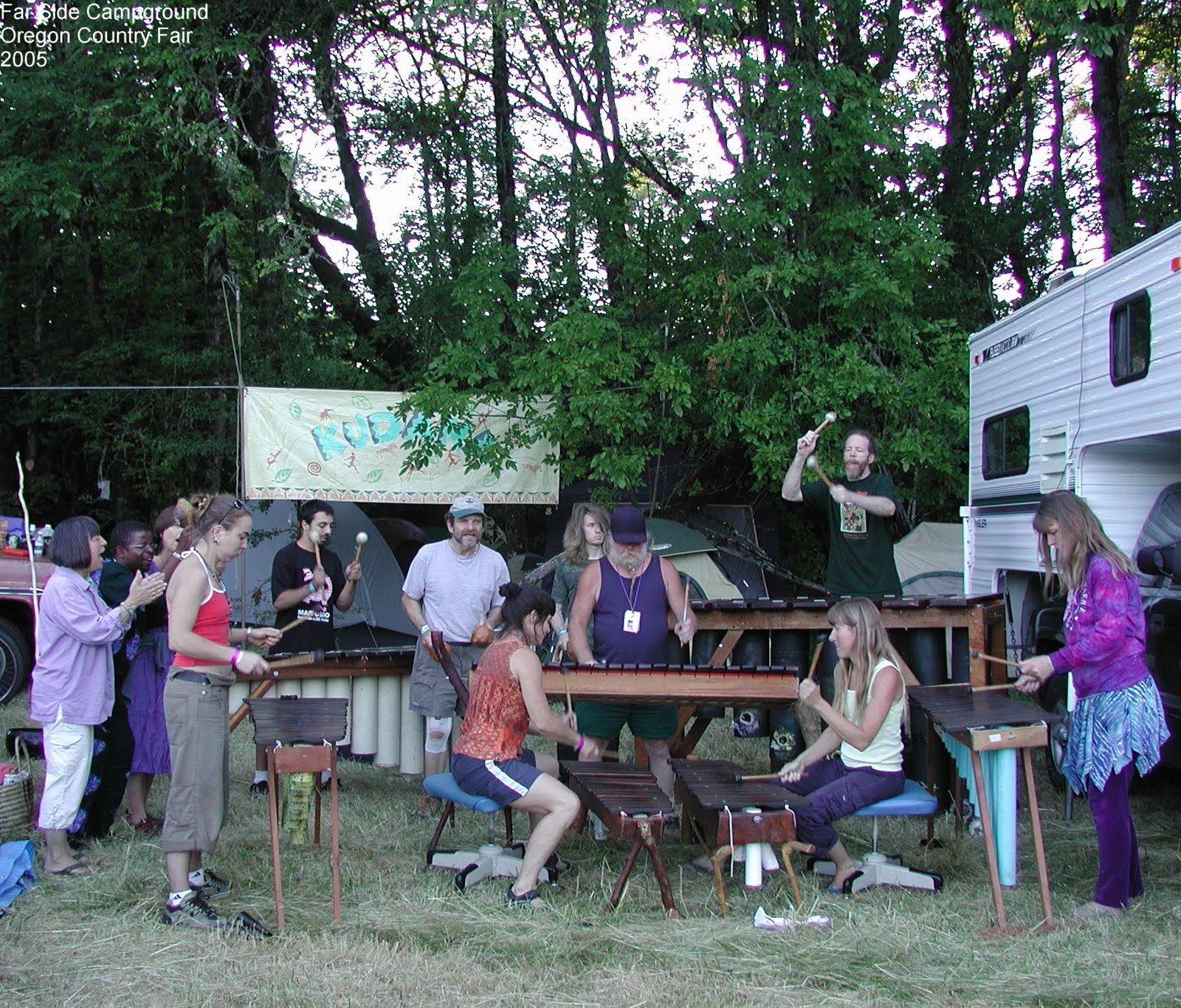
 Marimba jam at Far Side campground

The caliber of musicianship at this event is impressive and downright intimidating for casual guitarists like myself.  One year, I believe it was in 2001, fellow Mahatma Candy guitarist, David Thompson, and I arrived at the Fair, with our guitars slung over our backs, looking for people with whom we could jam.  As we made our way along the path, somewhere near Community Village, two young men were strapping on their guitars and invited us to sit and play with them.  As they tuned and ran through a few warm-up riffs it became apparent that neither Dave nor I would be able to contribute much:  both of them were professional-level musicians.  The moment was made quite awkward because a crowd had started to gather around us while we were setting up.  One of the two men pointed at Dave and I and said, "Are you folks ready to hear these guys jam?"  The crowd let up a cheer.  Dave and I looked at each other, and sheepishly withdrew into the crowd.  But we stayed to hear the two of them play.  And they were awesome.

"Hippie festival" is a descriptor often used in reference to the Oregon Country Fair, and I suppose that is accurate.  But most of the Fair people I know could not be described as "hippies" outside the confines of the Fair.  Which, of course, poses the question:  What is a hippie?

But I'm not gonna try to tackle that right now.  Just gonna go have some fun at the Fair.  I'll be back next week.  Have fun, all!

Monday, July 05, 2010

Mosey


A park in southeast Portland (at the intersection of Taylor and 17th) is named for Colonel Owen Summers.  Colonel Summers commanded the 2nd Oregon Volunteer Infantry in the Spanish American War.  He and the 2nd Oregon took part in suppressing the Philippine Insurrection, as well.

Having read Professor Zinn, I'm not inclined to view service in those conflicts favorably.  Those were misguided, imperialistic wars and nothing to be proud of.  But, according to the account written by Buck Private Joseph DeBurgh, a volunteer from Portland, it sounds as if 2nd Oregon performed admirably, that they were as humane as could be expected.  Second Oregon was nowhere near the Moro Crater Massacre.  I choose to believe that, had they been there, they would have done what they could to prevent it.  I'm that way about Oregonians.

Owen Summers
From what I have read about Colonel Summers (1850-1911), he wasn't a bad fellow either. A state legislator, a business man:  local boy does good.  He was orphaned at the tender age of seven, in Illinois.  He enlisted in the service of the Union against the Confederacy at 14 years of age.  Eventually, he settled in Portland.


There was a guy snoozing on the grass outside the fence at the Clinton Community Garden.  I imagine he was just passing through.  He and his dog had pulled up for a snooze in the grass.  It was a cool, gray day, but they had a nice napping spot, right in the middle of the lawn so that when the sun broke through, they got full benefit.  He was laying on his side in the grass, with his baseball cap over his face and his arm around his dog, who was zonked as well. 

I don't suppose anyone is much likely to name a park for that guy and his dog.

Nor for me, either.  C'est la vie, non?  I bequeath fleeting history to Colonel Wilson; he may have that for me.  My heart was more with the guy and his dog, catching some zees in the open air.

Friday, July 02, 2010

Grandfather Trilogy (Pt. III): The world they made

Dade, Eric, Ross, Jr. and Ross, Sr. at Disneyland
 The first meeting of my two grandfathers, Ross Cariaga and  Bob Metzger, was in Salem, Oregon, in July, 1961.  The occasion was the marriage of Ross's son, Ross, Junior (my dad), and Bob's daughter Bobbie (my mom).  They were two men from vastly different backgrounds, who found themselves in very similar places.  Each man was poised on the verge of middle age, watching as his kids began to leave the nest.

Bob Metzger and his three grandkids camping at Medicine Lake, CA

Bob came from the developing tradition of a native Oregonian.  He was descended from hard-working, ingenious Germans pushing westward from the prairies.  His were a noble, honest, and industrious people, emotionally reserved and stoic, but also kind, generous, and very, very responsible.  (Metzger family are often tormented by guilt.)

Ross came from the bleak life of agricultural labor.  He'd been his own man, with no social safety net to rely on beyond the friends he made along the way.  He had spent a lifetime forging a place for himself and his family on a new continent, thousands of miles from home.  Everything he had came from his own wit and initiative.  (Cariaga family are not patient people.)

Bob Metzger on family vacation in Utah

The last time my two grandfathers met was in January, 1992, in Klamath Falls, Oregon.  The occasion was the marriage of one of their two mutual grandsons, my brother Eric. 

The passage of time gives fuzzy edges to all memories, but I recall that it was winter in the Klamath Basin.  The air was cool, but not bitterly cold as it can be at that time of year.

It was the day before Eric's wedding when the plane carrying Grandpa Ross touched down at Klamath Falls Airport.

My fiancée and I had just finished checking in to our room at the Thunderbird Motel and we were standing in the parking lot with Grandpa.  Gray skies hung over our heads.  Grandpa was hat-less, wearing a tan-colored cardigan over his casual button-down shirt.  His slacks had perfect creases down each leg.  His gaze was cast downward at the faded blue-gray of the pavement.  He held one hand in his pocket, the other hung at his side.  "Is your Grandpa coming, son?" he asked me.

I said, "Yeah, Grandpa, he's coming on the train with my mom a little later today." 

Grandpa smiled to himself.  "Ah, okay, I'll go with him then," he said.

Grandpa Bob did, in fact, arrive later that night.  He looked appropriately Oregonian-casual when we picked him up at the train station in his corduroy pants and a light blue jacket.

The two men came face to face at Dad's house on Klamath Lake. They smiled as they shook hands. 

During that time of the wedding, the two were inseparable.  They made quite a pair, walking around Klamath Falls, having coffee at Denny's restaurant, chatting in the church pews at rehearsal:  the tall, broad-shouldered German, and the diminutive, brown-skinned Filipino.  It seems to me they smiled a lot as they talked.  It was as if they were two old friends who shared a lifetime of memories together, even though they had only met a handful of times. 

Ross, Jr., Ross, Sr., Don at my cousin Terry's wedding
When the wedding was over, the two men went their separate ways, never to meet again.

A year later, Grandpa Cariaga passed away.  Grandpa Metzger telephoned Eric when he heard the news.  "Eric, I'm sorry about your Granddad," he said.  Eric later told me that he could tell from Grandpa's voice that he was deeply moved by the news.  Five years after that, Grandpa Metzger passed, and his passing was the final adieu of my grandparents.

In some ways, Ross Cariaga, Sr. and Bob Metzger were polar opposites.  One was emotional, passionate, volatile; the other, staid, rational, understated.  In other ways, the two were very similar:  family men, doing their best to live up to their duty, as each of them understood it. Neither man had an easy life, but they had done more than just survive.  They had thrived.

The world I know is the world that was revealed to me by these two men.  It is a world revealed not only by the words of wisdom that they imparted to me, but also (indeed, more so) by who they were and by the way that they lived their lives. 

This completes the Grandfather Trilogy.

Thursday, July 01, 2010

Grandfather Trilogy (Pt. II): Ross Florentino Cariaga

Ross Cariaga, circa 1963

My paternal grandfather, Ross Florentino Cariaga, was born in the year 1913, in the Philippine Islands, which, at that time, was a territory of the United States. He was from the Ilocos Norte region (the same region from which came Ferdinand Marcos).  His mother died birthing him and so young Ross was partially orphaned at the very moment he entered the world.  Grandpa came to America at 17 years of age with other young friends from school, without his family and basically alone.  It was a decade before the Japanese invasion of the Islands in 1941, and when the war broke out, Grandpa was ten years in America, working as a migrant agricultural worker.  He harvested grapes, asparagus and pears all up and down the Pacific Coast for many years before wedding my grandmother, Jenny Rodriguez in 1938 and settling in Fresno, California.

Grandpa and Grandma had three children:  Rosalind (my Auntie Lina) born in 1939, Ross, Junior, (my father) born in 1940, and Donald (my Uncle Don) born in 1946.  The family lived in Fresno through the 40s and 50s before moving south to Coachella, California sometime around 1960. 

Me and Eric and Grandma and Grandpa Cariaga

Grandpa managed a camp for migrant workers (mostly Filipinos and Mexicans) outside Indio, California for many years.  Some of my earliest memories are of times out at "the Camp" as my family called it, playing with my cousins in the dry, oppressive heat of the Coachella Valley.

In the late 70s, Ross and Jenny divorced.  Sometime in the 80s, Ross remarried a Filipina, Gunding, with whom he remained married to the end of his life.  

In our family, Grandpa's word was not questioned.  All of his grandchildren learned from birth that Grandpa was to be obeyed and treated with respect and reverence. 

He was a small man, standing 5' 3", with a small stature.  But his expressive manner, especially when he was angry, would cause anyone to reel. He was notoriously impatient, and capable of quick, angry outbursts that would set you hopping to obey.  He would bark a command, in his heavily-accented English (the accent grew thicker when he was angry), thrusting his face forward, raising his eyebrows so that his forehead creased, flailing his hands.

Grandpa, circa 1992, a year before his passing

In my high school and college years, living in Klamath Falls, Grandpa would come visit every year.  At least once during each visit, Grandpa would spend an entire day cooking Filipino food for us all to enjoy.  Over time, we established the tradition that I would drive Grandpa to the various markets around town so that he could buy the food.  There were various meats, vegetable greens, lots of ginger, vinegar, soy sauce. 

We'd go to the market, Grandpa wandering through the produce section, or the butcher shop; me, pushing the cart behind him.  At intervals he would send me running off after some item or another.  For example, he would mutter:  "Son, go get the grapefruit," and as I started away he would say, "Get the big one."

I'd locate the grapefruit and carefully select the biggest one I could find, then come back with it.  "Like this, Grandpa?" I would ask, holding the fruit up for him to see.

"The big one!" he would shout, his eyes flaring, his chin thrust out at me.  "The big one!"  And, as I stood there flummoxed he would grab my hand and pull me over to the grapefruit stand where he invariably found a fruit that was bigger and riper than the one I selected.  There was always a warm affection behind his anger, and the entire oft-repeated exchange was funny to me.  Not that I dared smile.  Heaven forefend what that insolence might elicit!

Grandpa, the way I remember him
In later years, Grandpa became less animated, less volatile.  One of the last times I saw Grandpa, we had a  brief conversation about President Marcos.  It was shortly after Ferdinand and Imelda (ah, Imelda!) had been deposed and escaped to Hawaii. 

We were in the kitchen at Dad's house on Klamath Lake.  Grandpa was sitting at the kitchen table with the newspaper spread on the tabletop in front of him. I was standing by the cold wood stove.  The morning was warm and sunny, like most Klamath Basin mornings in the late spring.  We were sipping coffee.

The Islands were going through some unrest at the time and I was a young man, eager to draw firm conclusions from everything I saw.  "You know, Grandpa, one thing I'll say for Marcos:  he may have been crooked, but he kept the country together." Mentally, I braced myself for a rebuke.

Grandpa leaned back in the kitchen chair. His brown skin was dotted with liver marks.  A few sparse strands of hair still clung to his scalp at the very back of his head.  "Yeah, son," he said.  "He kept the country together."  He smiled, serenely:  a wide open-mouthed smile.  The deep wrinkles about his eyes grew deeper, more pronounced.  His smile said more to me than his words.  It was a gentle smile, tinged with a hint of resignation and satisfaction.  He made no attempt to correct what he surely must have thought to be the naivete of my opinion.  I had the sense that he was content with the man that I had become; the man that he helped shape.

I suddenly saw how much he had aged in the years since I had last seen him.

In 1993, Grandpa passed away in Palm Springs, California.  The Cariaga family lost our patriarch:  the man who came all the way across the wide Pacific Ocean to plant a seed in the New World.  We were all sad, of course.  But my own grief was assuaged by my faith that Grandpa, as he passed, was content with his legacy, with the progress of this thing he had started in America.  The gentle smile he showed me that morning in Klamath Falls had told me as much.

To be continued...

(Read Pt 1:  William Robert Metzger here.)

Wednesday, June 30, 2010

Grandfather Trilogy (Pt. I): William Robert Metzger

Bob Metzger circa 1966
William Robert Metzger was born May 22nd, 1916 in Gresham, Oregon.  He was a 2nd generation native of the state, the seventh of eleven children born to Frank and Josie Metzger.  He had a namesake uncle who had already laid claim to "Bill" so my grandfather was known throughout his life as "Bob."

He was born at the height of the War Over There.  Back then, ethnic and racial Germans were sometimes subjected to nativist animus, just as Muslims and Latinos are today.  Grandpa told me that, even in little Gresham, Oregon, which in those days numbered less than 2000 souls, the Metzger family endured the slur "Kraut."

Grandpa grew up a farm boy in the Willamette Valley.  Back then, Portland was half a day's journey from Gresham, and Salem was hell-and-gone.  Very different from today, where there is no clear delineation between Portland and Gresham, and Salem is but a 45 minute jaunt south on Interstate 5.

It was a different world, back then.  And, being a farm boy, Grandpa had an adventurous spirit.  More than once, he told me how, one day on the family farm, after he had graduated high school, some friends came by and told him they were on their way to Pasadena, California, to attend college.  On the spur of the moment, he ran inside the house, told his mother, Josie, that he was leaving, packed a bag, and set out with his friends.  Just like that. 

Bob was graduated from Oregon State College and newly-married to his sweetheart, Gertrude Baldwin-Metzger when the Japanese bombed Pearl Harbor, in December of 1941.  Bob and Gertrude had an infant daughter at the time, Roberta (or "Bobbie").

In the national effort to defeat fascism that followed, several of Bob's brothers (including Dick, Ed and Herb) served in the US Army, but although Bob tried to enlist, he was rejected because of scar tissue on his lungs from a childhood bout with tuberculosis.  The Great Depression was only just starting to ebb away, and there was a great sense of patriotism and civic duty, and years later, Grandpa expressed a sense of disappointment to me, that perhaps he had not done his part.

Bob spent much of his life teaching mathematics to high school students in Salem, Oregon.  He and Gertrude had two children besides Bobbie:  Jenifer, born in 1944, and Wayne, born in 1945.  Bob and Gertrude lived in Salem up until the year before Gertrude died in 1984. When Gertrude was diagnosed with ovarian cancer, they moved to California, where Gertrude had lived as a child.  Gertrude's death was a terrible blow to Bob. Although he would live another fifteen years after Gertrude passed, he longed for her always.

Grandpa returned to Salem, after Grandma passed, to live in a house just a few blocks from South Salem High School, where he had taught for many years.

Grandpa and me, 1988
After I moved to Portland, in 1988, one Saturday per month I would drive to Salem to spend time with him.  Ostensibly, I was there to help him with his yard work and his endless projects (he had a good dose of that German ingenuity), but most often my visits consisted of just hanging out, cooking and eating, and watching political shows on television.  Grandpa and I loved to talk politics.

Grandpa always named FDR as his favorite president. Grandpa may have been a lifelong Republican, but he was an Oregon Republican. That was back in the days when being a Republican did not require falling into lockstep with the party line.  Grandpa was a Republican in the model of Oregon's late great, much-beloved Governor Tom McCall.  The last Republican presidential candidate that Grandpa ever in his life voted for was Gerald Ford in 1976.  He cared not at all for Ronald Reagan nor for any of those who came after.  I am thankful he did not live to see George W. Bush installed in the Oval Office.  (As the old joke goes:  it would have killed him!)

In my childhood, Grandpa was a stern, noble figure.  But he was always quick with a joke, and his eyes often twinkled with merriment.  To me, he was the wisest man in the world.  As I grew up,  I judged the morality of my activities by whether or not Grandpa would approve.  This was especially true in the time when my mother, two closest siblings and I lived in Salem, in the years after my parents divorced.  (Of course, much of my behavior in those years would hardly have met with Grandpa's approval had he known.  But let's not go there.)

I learned a lot about patience and tolerance from Grandpa.  He never lost his temper; I never heard him raise his voice in anger.  Never once.

I learned about honor from him, too, although that's not a word I ever heard him use to describe his ethos.  He was utterly honest in all things.  He was always courteous toward others, always respectful. Grandpa was also very out-going, very friendly.  He never failed to extend his hand to anyone who came into his life.

Granpda and Aunt Jenifer, 1993
In his last few years, Grandpa's mental faculties started to break down.  There were disturbing incidents:  he sometimes forgot where he was driving, or forgot to turn off the burner of his gas stove, or, most painfully, came to suspect that his grandchildren were stealing from him.

He was diagnosed with Alzheimer's Disease in the mid-90s.  Although he never deteriorated to the point that he did not recognize his family, he nonetheless suffered from cloudy, befuddled and sometimes paranoid thinking.  In moments of lucidity, he recognized the decline and it frightened him.  Physical decrepitude was one thing, but to lose one's mind...

In 1999, while I was traveling on my Grand European Tour, my family finally convinced Grandpa that the time had come for him to enter an assisted living facility.  He was not happy to lose his independence, but he recognized the need.

That Christmas, my family gathered in Eugene, at my brother Eric's house.  My Uncle Wayne picked up Grandpa at his new home and the two of them drove down to join us.  At the gathering Grandpa was more quiet than usual.  Only later did we learn that he wasn't feeling well; it wasn't like him to complain.  Six days later, on December 31, 1999, Grandpa succumbed to pneumonia.  He was 83 years old.

About a year before he passed, Grandpa told me rather soberly that he had already lived to a greater age than any other male in his family.  I can still see him, sitting in the recliner in his living room, shrugging as he said it, as if it were some unfathomable mystery.

I've always suspected that Grandpa made a conscious decision when his time came.  His older sister, Maude, had passed earlier in the year, and I think Grandpa felt that with her passing, he had accomplished all that could be expected of him regarding familial duty.  His children were all on solid footing, his grandchildren were adults.  He had no reason to linger.

He was not a religious man.  He never expressed a belief in an afterlife or a Heaven.  Regardless, I know that when he passed through the Veil, he reunited with Gertrude and with Frank and Josie and all his brothers and sisters who had gone before.

I figure that now, he's sitting back watching, waiting for the rest of us.

To be continued...

Monday, June 28, 2010

Movie Review: The Karate Kid


Director Harald Zwart's 2010 remake of the 1984 coming-of-age classic, The Karate Kid, may be short on originality of plot (in fact, apart from the setting, the story is identical), but don't let that stop you from going to see it.

Twelve-year-old Dre Parker (Jaden Smith) must leave his home in Detroit for Beijing, where his mother, Sherry (Taraji P. Henson) has work with an automobile manufacturer.  As Dre attempts to integrate himself into an alien culture, he runs afoul of a gang of bullies trained in kung fu.  Mr. Han (Jackie Chan), the maintenance man at the apartment building where Dre and his mom reside, reluctantly agrees to help the boy in his quest to earn respect.  The story unfolds more or less predictably from there.

But Zwart's creation is poignant.  Jaden Smith's performance is moving.  With Zwart's direction, Smith achieves just the right combination of vulnerability and cocksure youthfulness.  The interaction between young Dre and his Chinese crush, Mei Ying (Wen Wen Han) is awkward and (dare I say it?) cute.  Jackie Chan's performance is vintage Chan:  funny, charming, charismatic.

The fight scenes are well-choreographed and entertaining, although parents of young children (younger than 10, perhaps) should consider carefully.  There is plenty of (non-lethal) violence.

The movie also endows viewers with a glimpse of modern day Beijing which I, at least, found surprising.  Far from a colorless Communist monolith, the Beijing presented by Zwart is bustling, alive, and full of surprises.

The biggest surprise of all, for me, was how much I enjoyed this movie.  I had gone in expecting a trite, shallow adaptation of a moderately good flick from my youth.  Instead, I got a beautifully rendered, well-acted, touching portrayal of the timeless trials of a boy emerging into manhood.

Good flick.  I recommend it.