Wednesday, October 07, 2015

Farewell to New York and to Maty


Easy as pie
New Amsterdam, it's become much too much
'Til I have the possession of everything she touches
'Til I step on the brake to get out of her clutches
'Til I speak Double Dutch to a real double duchess; --Elvis Costello

As I write, Maty and I are in Newark International Airport, seated at the gate where she will board her flight for Houston, Texas in a scant hour. We will soon part ways, she to visit family in the Lone Star state, I to ride the rails from Lisbon to Amsterdam over the course of the next month. We'll be reunited in mid-November, back home in Portland.

Maty in Times Square
What to say about New York? Any words I might tap out will, of course, be inadequate. New York is the center of the world. You can see it in the array of races and ethnicities of its inhabitants; you can hear it in the multitude of tongues that resound on its streets.

Outside ABC Studios
The exhilaration I felt wandering through the streets, the sheer adrenaline, was as powerful as any drug. While I wandered through Central Park, I looked up at the high-rise apartments and imagined what it might be like to live there, at the center of the universe. "If I had 10 million dollars, I'd buy a place, right here," I thought. "I'd move us into it, and we'd never leave. We wouldn't have to. The world would come to us."

But I'm never going to have 10 million dollars. Not in this lifetime. It's just a wistful dream. And, anyway, I think I love my little Rose City too much to leave her.

Maty and New Yorks' Finest
We spent our last day in Gotham wandering around Times Square, people watching, spell-bound by the dazzling displays. We ate lunch at a French bistro. We cast aside any pretenses of being above it, and gawked like the tourists we were.
Manikin retinue in H&M Times Square
And, for tourists, of course, New York is enthralling. But I spoke with a couple locals, and for them, the reality is a little different. "There is a lot of stress, working here," said a young black man I met in the bistro. He works for a bank in Times Square. "I'm here every day, and there is a lot of stress. I commute in from New Jersey every day. I can't afford to live here in Manhattan." 
Tatted New Yorker
On the subway, when we were returning to Staten Island, I met a man about my age --a tall Russian fellow --with two young children in tow. "When I came to work here, my employer warned me, almost as a point of contract, that I must be sure to leave the city regularly. The adrenaline will burn you out in short order, if you don't."

I suppose it must be that way.

Lovely day in Lincoln Square Park
Nonetheless, I love New York City. Maty loves it, too. We'll be back someday, God willing. But now I must sign off. My wife is getting ready to board. I've got a lump in my throat as I prepare to say goodbye to her. I hope I don't make a fool out of myself by blubbering in front of God and everyone.

More from Europe, dear reader. But for now, farewell.

Tuesday, October 06, 2015

NYC: Petite Senegal and the Metropolitan Art Museum

Sunny day in East Village
Sunday, the day after I went to the American Museum of Natural History, and Maty's visit with friends in the Bronx, we took the train to East Village in Manhattan to meet with my friends JR Tracy and Paul Haseler. JR and Paul are brothers in the international fraternity of Advanced Squad Leader players. I tell you, the very best rewards of being a gaming geek are the hundreds (literally, hundreds) of friends I've made because of it. Here in the United States and all across the world.

JR and Paul,
JR lives in Chelsea, in Manhattan, and graciously reached out when he heard I was coming to New York. So we met up for brunch at a place called The North Spy, famous for its corned beef hash and biscuits. Trust a Manhattan native to know the best places to eat! Maty, whose culinary tastes are as refined as they get, loved the corned beef hash (as did I) and we both enjoyed the company. The last time I saw JR was about 20 years ago at a gaming tournament in Maryland, and I'd never actually met Paul before (he being from Sydney, Australia). But, of course, as friends with a common hobby will do, we conversed animatedly throughout our meal.

Le Petite Senegal in Harlem
Afterwards, Maty and I made our way up to Harlem, where I had heard was a Senegalese neighborhood, Le Petite Senegal.The rain that greeted us when we arrived in New York gave way to beautiful sunny skies and pleasant temperatures. We emerged from the subway at West 116th Street and Lennox, and soon began to notice men dressed in traditional Senegalese boubous and hearing people conversing in Maty's native tongue, Wolof.

Maty finds her countrymen
Maty was thrilled, of course. She was soon laughing and speaking with random people on the street.

Maty, making friends in Little Senegal
We found a Senegalese restaurant for lunch, where I had yassa chicken. It was very good, but I hold that there are very few in this world who can prepare Senegalese food as well as my wife.

Yassa chicken
We wandered around the neighborhood for a while. I found a hat I liked in the market and we descended into the subway to make the long trip back to Staten island.

My new travel hat
Next day, Monday, Maty was too tired to go out. I was tired, too --we'd been going hard for the last three days --but I could not sit idle in our rented apartment while Manhattan beckoned. So I set off alone to journey into the city, while Maty stayed behind to watch her Lifetime movies.

Pigeons roost on a stony thinker in Central Park
My objective for the day was the Metropolitan Art Museum in Central Park. I took the 1 train from South Ferry up to 59th Street and emerged to a sunny, mild October day: perfect weather for a walk in the park.

Workers enjoying the park
My stroll evoked memories of the last time I visited New York City. That was in 2000, almost a year to the day before the infamous events of 911. Brother Eric and I had walked through Central Park back then, and our route more or less corresponded to the route I took on this occasion. Vague recollections emerged on the Literary Walk, and at Bethesda Fountain.

Skyline above the greenery
Soon enough, I came to the Metropolitan Art Museum, where people entered and emerged like so many purposeful ants.

I entered eagerly. 
Lamentation
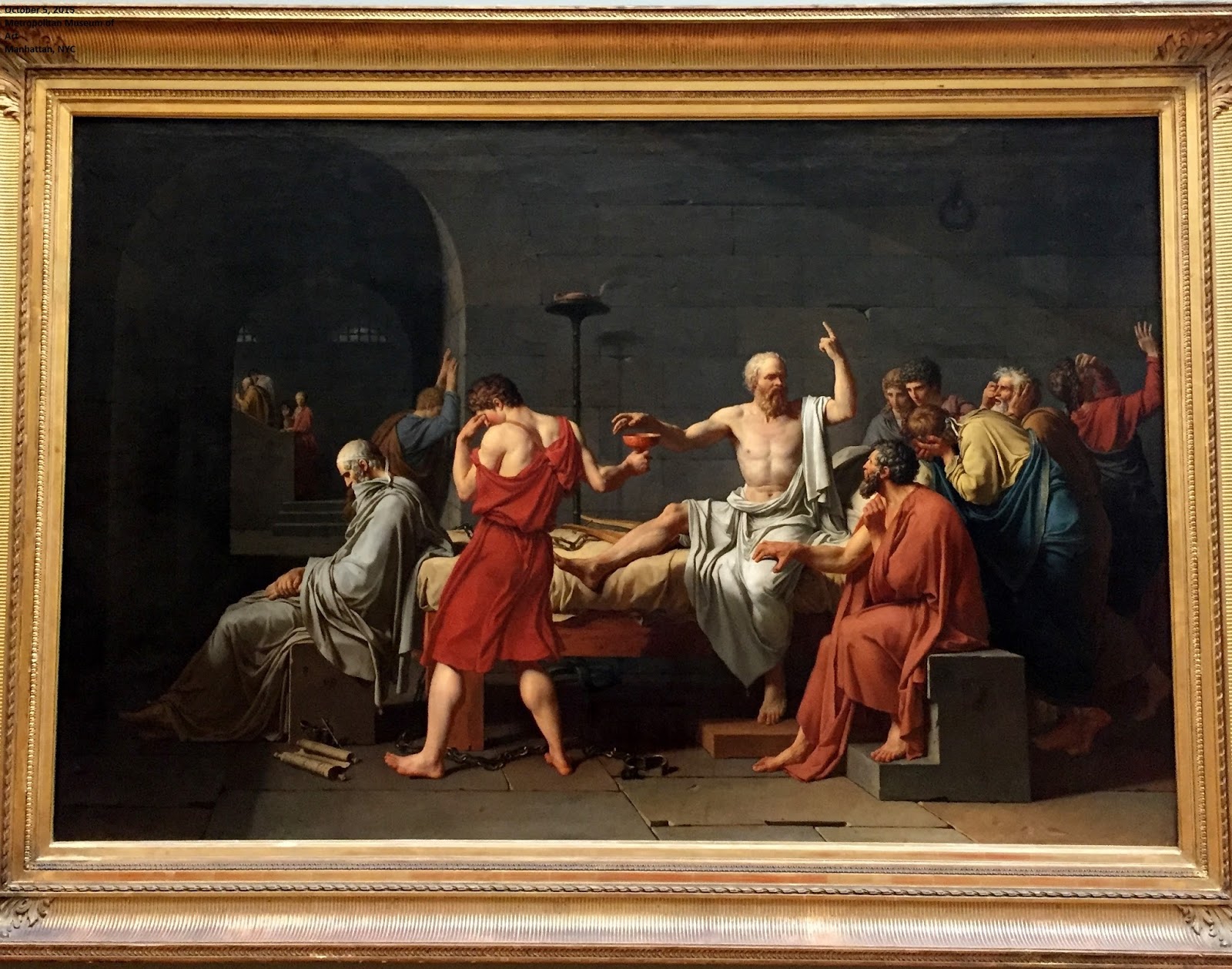
I spent a good three hours viewing masterwork paintings and sculpture, art from Africa, medieval armor. It was an overwhelming sensory experience, as well as an emotional one. I include, without commentary, just a few of the sights I beheld.

The Death of Socrates

Stained glass

General Washington crossing the Deleware

Yosemite

Medieval cavalry

Suit of armor and polearms

Mr. Satyr has a not-so-little problem, eh?
Okay, couldn't resist a little ribald commentary on that last sculpture. Heh.

I was spent by the end of my museum tour, so I trekked back to 59th Street and took advantage again of New York's superlative mass transit system to eventually arrive back at our apartment on Staten Island. Maty and I ordered out for Indian food, which was delivered with alacrity. This is New York City, after all.

The next day would be our last full day in the city and the last day we would have together. We slept well that night.

Sunday, October 04, 2015

Natural history and the $16 pastrami sandwich

Financial District, Lower Manhattan
The weather had calmed by Saturday morning. The blustery winds were gone and, although the rain threatened, it mostly held off. Wet pavement and cloudy skies greeted us as we stepped off the Staten Island ferry and onto Manhattan.

Intricate architecture
We walked through the Financial District where the streets seemed abandoned, at least by New York standards. It was Saturday and I suppose the financial moguls, stock traders, and white-collar flimflam artists were away at their homes (high-rise apartments on Park Avenue? urban mansions out in Queens?) counting their money.

New York Stock Exchange building
We came upon the famous Wall Street Bull which was being mobbed by a group of aggressive Chinese tourists. They thronged around that unfortunate beast, snapping pictures, jabbering excitedly, and basically boxing out anyone else from getting a photo. "We're hoping they all leave at once," said a young man who stood with his wife, waiting patiently for an opportunity to get a commemorative.

Maty would have none of it. "I'm going to get a picture," she said and waded right into the melee. I followed close behind.

The mob resisted. One particularly obnoxious fellow stood right in front of the bull, snapping pictures as if he alone had the right. A woman screeched at me and pushed my shoulder as I made my way forward. But Maty made it past them all and posed herself next to the bronze beast's snout and I screened off the photo-snapping solipsist. In one swift motion, I focused and shot. You can see the result below.

The Wall Street Bull
As we shouldered our way out of the buzzing, vaguely hostile crowd, we again encountered the couple we'd spoken to earlier. "You just gotta force it," I said to the young man. "Don't worry about being polite. They're sure as hell not." He nodded grimly and I saw them wade into the fray.

George Washington praying for a miracle at Valley Forge
Our first objective for the day was to deposit Maty with her friend, Oomie, who lives in the Bronx. Oomie is the aunt of our dear sister Nadia, and Maty wanted to pay respects. So we found our way into the subway and took the long ride up to the Bronx, where Oomie greeted us.

Maty and Oomie
Rather than go with the women who, I knew, would spend the day chatting in French, I caught the train back down to Manhattan to find a museum. The first I encountered was the famous American Museum of Natural History. I'd been there before, when I came to New York in 2000, but that visit had been rushed and so I was eager to see it again.

Mammoth bones
The American Museum of Natural History is not a place for quiet observation and contemplation.  It soon became apparent that the people who were missing from the Saturday streets had transferred themselves into the museum. It was packed.

Pre-human ancestors
Nonetheless, I spent a good several hours viewing fossils and dioramas. In particular, I enjoyed the Hall of Human Origins. It's a subject I find endlessly fascinating. For some reason, I was saddened by the dioramas depicting Australopithecus, Neanderthal, and early humans. I imagined the people who had made the displayed artifacts and left behind the fossilized bones and wondered what tragedies and joys they must have experienced all those ages ago. It somehow didn't seem fair that we, the people of today, could look back on them with such dispassion and objectivity. Whatever.

A trilobyte
After the museum, I took a stroll through Central Park. I was hungry by this time, and Maty would still be having fun with her friends in the Bronx. So I went in search of sustenance.

Central Park
I found a couple posh-looking places on Park Avenue but a glance at the menus on the windows convinced me that they were not for me.

Alice in Wonderland
I eventually found a deli at 79th and Lexington that boasted the "Best Pastrami in the World." I was famished at this point, and I love pastrami, so I went in. It was a tiny place with 4 small tables, two aproned men behind a stainless steel counter, and another fellow waiting tables. I ordered the house special: pastrami on rye with a dish of dill pickles. The sandwich was $16.

I was taken aback by the price, but having secured a seat at the table I was too embarrassed to walk out. And let me tell you, it was worth it. The sandwich was over-stuffed with pastrami. No lettuce, no condiments, no tomato. Just pastrami on rye. And it really was the best pastrami sandwich I've ever had.
This is how you get around in New York
Afterwards, I got subway access at 77th and Lexington and made my way back to the Bronx to get Maty. By now, I'd become familiar enough with the subway system to have confidence that I wouldn't get lost. (As an aside, I'm learning that a smart phone is essential these days for travel. And there are numerous New York subway apps that will help you plan your route.)

Maty met me at the Prospect subway station and together we made our way back to South Ferry, where we caught the Staten Island ferry back home. A long, rewarding day and we were both exhausted.

Another day in New York City. Let's see what tomorrow brings.

Saturday, October 03, 2015

First day in the Big Apple

Lower Manhattan skyline
New Yorkers call Staten Island (population ~470,000) the "Forgotten Borough." After all, Staten Island has only a third of the 1.4 million people that live in the next smallest borough, the Bronx, and only one-fifth of Brooklyn's 2.5 million.

It is both humbling and intimidating to this Oregon-born, Portland resident, but the fact is that were we to transplant my beloved Rose City to New York, all of Portland --the Rose Quarter, downtown, inner Southeast, NoPo, Saint John's, Southwest, all of it--would comprise only an undersized borough in this great city.

New York: the greatest city in the United States, the financial hub of this country and the cultural hub of the entire western world.

Maty and I arrived at Newark International on Thursday evening and caught a taxi to Staten Island, where we're staying in a basement apartment right off the bus line that takes us to the Staten Island ferry and thence to Manhattan.

Heading to Manhattan
On Friday morning, we set out to see what we might see. The weather was god-awful: slashing rain and gusting winds. Nonetheless, we soldiered out into it and made it to the ferry. New York's public transportation system is a marvel. Buses run every 15 to 20 minutes and the Staten Island Ferry runs every hour, 24 hours a day.

We'd no sooner stepped off the ferry onto Manhattan Island than we were approached by a fellow who pitched us tickets for a tour of New York harbor. Thirty bucks each would get us on a tour boat that would take us around the harbor with good photo opportunities for Ellis Island, the financial district, and, of course, the Statue of Liberty. We accepted and set off on foot for Pier 15. The half-mile walk to the pier was an adventure in itself, with the howling wind and driving rain. Our umbrella availed us little. Our shoes were soaked. But we made it.

Exuberant Maty and the Lady of the Harbor
The boat tour, alas, was a bit of a disappointment. It lasted less than an hour and the weather was so miserable that we spent most of the time huddled in the enclosed deck, peering through fogged-up windows. But we did get some good photos of Liberty, so it wasn't a complete shut-out.

Once we got back on shore, we found the Wall Street subway station and went on down with no fixed destination in mind. It was warm and dry in the subway --a welcome respite. A river of humanity bustled in the labyrinthine passageways below the street. I was struck by all the faces, all the languages, all the purposes.

We decided to go to Times Square to see what we might see.

Times Square panorama

Steel and glass canyons. Bewildering displays on huge screens. A cacophony of blaring horns. Sidewalks filled to capacity and beyond. We wandered around, aimless, amid it all. I was surprised at the friendliness and patience of the people we encountered. At several points in our meanderings I worked up the gumption to ask for directions and invariably the persons I asked were helpful and friendly. One fellow, sharply dressed and groomed with an air of importance and professionalism, saw us huddling under our shared umbrella, and without a word, gave us an extra that he was carrying.
Times Square
The impressions were coming fast and furious and I quickly fell under the spell. We wandered around for a while and then, wet and tired but exhilarated, we made our way back by subway to the Staten Island ferry.

Short step shuffle onto the Staten Island Ferry
Our first day in New York was complete. As I write this, Maty is coming awake and we're getting ready to set out again. Let's see what the day will bring.

Sunday, September 27, 2015

Stepping off

Thinkin' about it, dude?
In my youth, in the 70s and 80s, we had a swimming hole.

The Topsy Recreation site is a plot of volcanic rock and Ponderosa pine along the Klamath River, about 10 river miles west of Keno, Oregon. In the summer, teenagers would drive along curvy, 2-lane highways from Klamath Falls to Topsy, to drink beer and smoke dope and go swimming.

There is a particular spot just off Topsy Grade Road where we went. It is a flat spot at the top of lichen-clad lava rock columns, 30 feet above the river. That is where we would go.

The sun blazed in those days, almost every day. (Or that is how it seems now, 30 years later.) In the heat, the ripples on the water tantalized and invited. When you'd cooked long enough, there was a point on the rocks where you could stand and, if you worked up the nerve, you could take the plunge.

To do so, you had to steel your nerves. The river runs slow at the point (it is just above the dam). You can't see far into the murky water. And the jump itself, required commitment and follow-through. Once forward momentum had started, you had to keep going. You had to push off hard to clear the rocks below.

Lunge, plant, launch.

It was an act of faith. Thirty feet is a long way down. 

When you started the jump, when the thing in your brain tripped and started moving your body forward, there was a magical feeling that came over you. Even before your launching foot had lost contact with the scaly rock, there was a heart-stopping "no turning back now" moment. Determination and fear, exhilaration and resignation all at once.

For good or ill, the act was underway.

Today --now --as Maty and I spend our last weekend at home, that same sensation stirs itself from my memory. Forward momentum has commenced. A journey is upon me.

From Manhattan to Lisbon, thence across Spain and France. A Eurail pass and a vague itinerary. Five weeks. I'm looking for a muse. A once faithful friend who has become a stranger.

The act is underway.

Thursday, September 17, 2015

Citoyen des États-Unis

Citoyen des États-Unis
Maty hit a big milestone today. Today, 228 years to the very day since the Constitution of the United States became the law of the land, Maty took the Naturalization Oath of Allegiance, administered by a federal judge in the Mark O. Hatfield United States Courthouse. She is now a citizen of the United States of America.


Federal Courthouse, courtesy of Senator Hatfield
When I step back and examine the long journey this woman has undertaken, at how far she has come, I can only shake my head in amazement. Consider:

At 24 years of age, Maty left her family and home in the dusty African city of Ouagadougou, half a world away, to make a new life for herself in the far away dreamland they call America. She came here to serve as a nanny for a young family in Portland. The year was 2004 and the father of that family had been called to serve in the Iraq war. The mother, an immigrant from Africa herself, needed help caring for her two children. The baby boy, Matthew, was a special needs child.

At that time, Maty commanded a mere handful of badly pronounced English words and phrases. She was (and is) an excellent cook and a coiffure and she had (and has) a beautiful capacity for empathy and compassion, but beyond those, she had no "marketable" skills.

Nadia reassures Maty, who waits nervously to take her seat in the well of the courtroom
In the ensuing eleven years, Maty has:
  • learned to read, write, and speak English;
  • earned state certification as a nursing assistant;
  • learned to drive a car and obtained an Oregon State Driver's License;
  • joined a union and worked as a health care professional;
  • and now, become a citizen of the United States of America.
Naturalization oath administered 
She has also traveled, by herself, across the world and the United States and has surrounded herself with an entire community of people for whom she is family. (She also got married, somewhere in there.)

Thoughtful, when it was over
On the drive from the courthouse, Nadia and I quizzed her about her plans for the future. "I want to learn to swim," she said. "And I want to go back to school for more English studies."

So, although she's very proud to be a citizen of this country, she's not resting on her laurels.

Lady of the day and her proud hubby
Perhaps the most amazing quality of this woman, in my mind, is her humility. When I told her I planned to write a blog post about her Big Day, she told me, "Make sure to write that I say 'thank you' to God.'" She is devout, my woman.

"And say thank you to Matthew, too. He's the reason I came here."
Maty and Matthew
Maty. So full of love and compassion. And so determined and strong. America and I are lucky to have her.

Sunday, September 13, 2015

Book review: All the Light We Cannot See


As near as I can tell, Anthony Doerr's latest novel, All the Light We Cannot See, is the current favorite of book clubs all across America. I learned of the book because my mother had read it as the selection for her book club. And fellow book club member Jim Kidwell's mother had also read the novel because it was the choice for her book club. It stands to reason, considering that the novel was this year awarded the Pulitzer Prize for Fiction. And judging from the reception the novel has received from the literary press, Anthony Doerr has set his feet firmly on the path toward that most elusive of states: "successful novelist."

All the Light... is set in the small seaside town of Saint-Malo in France during World War II. A blind French girl, Marie-Laure, huddles in the home of her eccentric uncle, abandoned and alone, the unwitting guardian of a secret treasure. At the same time, a conscripted German soldier, Werner, the orphaned German boy with a talent for understanding radio circuitry, works to find the source of radio signals that have been emitting from within Saint-Malo, relaying information to the French Resistance. Even as the two of them ponder their respective predicaments, pamphlets warning of impending bombardment blow through the streets of the nearly-empty town.

As the novel progresses, we learn the circumstances and events that have led to this situation. Marie-Laure is the daughter of the locksmith at the Paris Museum of Natural History, separated by the tides of war from her father and her Paris home. Werner, because of his technical acumen, has been conscripted into the National Socialist movement, where he is told that cruelty and ruthless efficiency are virtues. As the war grinds forward, these two protagonists, seemingly set upon divergent and opposing paths, are somehow drawn together, somehow presented with an opportunity to bring about the triumph of compassion and humanity over unspeakable evil.

I found Doerr's prose to be compelling and humane. He masterfully sets a mood of dreadful expectation in the opening lines of the novel and that expectation is maintained. He has a knack for inserting descriptive sentences at precise intervals so that the reader never loses a sense of being present in the moment. I found it interesting and perhaps suiting that Doerr does not delve deeply into the specifics of Nazi cruelty, but skirts delicately around the most horrible events.

Consider this excerpt. Werner has come to the sick ward of the Nazi youth training camp to check on his friend, Frederik, who was beaten by bigger, stronger boys in the school:
A single bed with blood in it. Blood on the pillow and on the sheets and even on the enameled metal of the bed frame. Pink rags in a basin. Half-unrolled bandage on the floor. The nurse bustles over and grimaces at Werner. Outside of the kitchens, she is the only woman at the school.
"Why so much blood?" he asks.
She sets four fingers across her lips. Debating perhaps whether to tell him or pretend she does not know. Accusation or resignation or complicity.
"Where is he?
"Leipzig. For surgery." She touches a round white button on her uniform with what might be an inconveniently trembling finger. Otherwise her manner is entirely stern.
"What happened?"
"Shouldn't you be at noontime meal?"
Each time he blinks, he sees the men of his childhood, laid-off miners drifting through back alleys, men with hooks for fingers and vacuums for eyes; he sees Bastian standing over a smoking river, snow falling all around him. Führer, folk, fatherland. Steel your body, steel your soul.
"When will he be back?"
"Oh, she says, a soft enough word. She shakes her head.
So much is said without elaborating on the horrible details of what happened to the boy. Some might call this a cop-out, but I disagree. In much of today's literature, gruesomeness and unsettling details seem to be the trend. (Read any Cormac McCarthy novel for examples.) But I found Doerr's approach more palatable and no less effective. Any book that deals with Nazis and World War II is necessarily going to touch on some nasty subject matter. But this novel is written in such a way that even my delicately sensitive mother could enjoy it. And one can easily argue that by leaving the details to the reader's imagination, the cruelty is more mysterious and terrible.

All the Light We Cannot See is a poignant coming-of-age novel, with well-drawn characters that I genuinely cared about. It successfully depicts the cruelty of war and the corruption of National Socialism, of how it victimizes even its own adherents.

After reading this book, I'm eagerly anticipating Doerr's next novel, whatever it may be. I highly recommend this novel.