Thursday, July 15, 2010

OCF 2010: So, how was the Fair? (Pt. III)

Another tomorrow in the brief dusty march completed.  A sojourn through the hippie duality of hedonism and social awareness:  Oregon Country Fair, 2010.  

Enough preamble, what?  Let's talk about the Fair experience this year.

Main Stage

Music

The Fair is always full of great music, whether it is a name band on Main Stage (this year's ensemble included The Gourds and Portland's own Tap Water) or a roving minstrel playing along the path in the Magic 8.  This year, I saw very little music, but there are two performances that stand out in my memories.  

Young rappers
The first of these, was an impromptu rap performed by three young men in the area just off Main Stage.  One of them laid down a fantastic rhythm while the other two traded raps.  The performance was as live as it gets, totally unrehearsed, made up as they went along, and they never lost beat nor faltered as they commented on the Fair, on passers-by, on the weather, on societal issues, and hippie-dippy love.

Eventually, they attracted the attention of a stunning young woman with clear, mocha skin, and an unruly blonde-brown afro in a revealing skintight dress.  She boldly stood directly in front of them, one hip slung to the side, admiring their skill.

Thought I, "This will cause them to hiccup."  But they kept rolling.  They even incorporated their new admirer into their rap:

"I like the way that you wear your dress, and, and, and,
I like the way it makes my head a mess, and, and, and..."

The woman smiled, an honest, closed-lip smile.  I got the feeling that, while she was definitely impressed, the lads were going to have to work harder than that.

Plea to the Four Winds
The other musical performance that stuck with me was the Native American prayer dance I witnessed on Sunday, as I was leaving.  A Native American shaman blessed the Fair with a peace and harmony dance.  His face was painted black and white; he waved an eagle feather to the Four Winds.  The drum circle behind him cried out their haunting prayers in warbling coyote voices, while the dead, relentless beat pushed on.  It was a stirring experience.

"Man, why can't it just be this way all the time, man?  'Cause, ya know, man, it's love, man.  Ya know, if people would just love each other, man..."
Servant of Love in the Hippie-dippy Love Cocoon

Saturday evening, I ventured out of camp and into the Fair.  In an astonishing display of initiative (all things considered) I managed to time my entry at the top of the "Magic Eight" such that I arrived in the wake of the Sweep.  Very dusty, it was, but the crowd was as thin as it would ever be.

My objective was to grab a bowl of Stir Fried chicken yakisoba, take a look around, then head back to camp and relax.  I got my heaping bowl of yakisoba with the tender, slow-cooked chicken (delicious!) and looked around for a place to eat.

At a nearby table, sat two men.  One appeared to be what one imagines when one thinks of the South Valley country hippie:  a weather-worn fellow, with long iron-gray hair pulled back in a ponytail underneath a mangled straw hat.  He wore khaki shorts, sandals, and a bright tie-dyed tee-shirt, splotched with red, blue, yellow and green.  His face was well-wrinkled and tan, making it difficult to estimate his age.  He could have been 45 or he could have been 65.

Seated across from him was another man.  This fellow was perhaps in his late 40s or early 50s.  His sole vestment was a pair of cut-off shorts.  He was in excellent physical condition, as I could plainly see.  His skin, from the top of his bald pate to the tops of his feet, was evenly browned in a healthy tan.  He was barefoot, with one foot tucked up under his rump.  His hands were folded on his knee.

"You fellas mind if I join you?"  I asked, with a smile.

"Well, I'd mind if you didn't!" responded the country hippie, with a broad, sincere grin.

"I'm Dade," I said, extending my hand.

"I'm Charley," replied the country hippie.

We shook.

Charley's companion looked my way and smiled a beatific smile.  His pupils were as wide as saucers.  Aha! thought I.  This fellow has recently embarked on the Long Solemn Dream.

Charley saw my yakisoba and excused himself to go get a bowl of his own, leaving me and the dream voyager alone at the table.

"You know," says he, "as a first-time Fair-goer, it feels good to be home."

Here we go, thought I.  I said, "What do you mean?"

"When you see love like this, you just know it is true and right," he said.  He was wrapped up tight in the hippie-dippy love cocoon. "Why can't people see it?  Why can't it be like this everywhere?"  He winced gently, thinking of all the unenlightened souls who are screwing up the world.

"First-time Fair-goer, right?" I asked.

He nodded.

"Well, I'm not trying to bring you down or anything, but I've been coming to this party for twenty years now.  One thing I've learned is that behind this veneer of social responsibility and all the peace, love, dope window-dressing, people are still people.  The good and the bad."

He looked at me with serene befuddlement, as if I were a speckled toad hopping across his picnic blanket.   But only for a moment.  I saw his eyes grow wider and more solemn as he sank even further into the Long Solemn Dream.  He blessed me with a tolerant smile.  "I choose to hang on to the love, brother," he said.

"Fair enough," I said, only vaguely aware of my own pun.  I finished my yakisoba and stood up to go wander.  I gave him a smile.  "Anyway, have a good Fair.  What was your name again?"

"My name is--"  He thought for a moment, then in a surge of enlightenment answered "--Servant of Love."  His passive, love-bombed, fully-dilated eyes met my own in peaceful defiance.  He rested his chin on his folded hands which, in turn, rested on his drawn up knee.

"Is that what you want me to call you?" I asked.

He shrugged.

"We'll talk again in 10 years," I said.  I gave him a wave, and set off to find some music.

I'm not smirking, you understand.  I've been there.  When one is in the grip of the Long Solemn Dream anything seems possible: our most cherished hopes about God and humanity and the benevolence of existence. That feeling, the one that comes with belief in a Universal Good, might even linger for a while, afterward.  But the human spirit is a sieve.  Eventually, it all leaks out and leaves you tired and dusty.

An ent at the Country Fair
Starry night on the Far Side

There is no surer sign of the passage of time than that on Saturday night, in lieu of attending the Midnight Show, in which all performers in the Fair take the stage for brief encore performances, the Watergate crew chose to pull lawn chairs out into the grass of Far Side field and admire the stars.

A dozen or so of us sat and star-gazed and relearned our constellations:  Big and Little Dippers, the North Star.  Myk Walker pointed out Scorpio.  Talk was subdued, but meaningful.  Kids were running all around us with glow-sticks.  Mark Greinke was tossing a glowing Frisbee around.  Someone nearby was projecting a laser light show onto the trees at the edge of the field. 

There was a time, not so long ago, when our camp would have been empty, everyone having gone in to the Fair to see the Midnight Show, and would remain empty until nearly dawn, when straggling, loaded hippies would creep back to their tents to catch a few minutes of sleep before Sunday morning shift began. 

And I guess maybe it means I'm settling in to middle age, but I didn't miss the heavy drinking and partying and staying up all night.  I found that I much preferred the stars.

To be continued...

Wednesday, July 14, 2010

OCF 2010: Working at the Fair (Pt. II)

Another tomorrow in the brief dusty march completed.  A sojourn through the hippie duality of hedonism and social awareness:  Oregon Country Fair, 2010.  Read Part I here.


Being part of a working crew at the Oregon Country Fair comes with both privileges and responsibilities.

The privileges are obvious.  Working crew get to stay past the Sweep and enjoy the Fair after the general public has gone home.  Working crew generally camp at the various campgrounds on the periphery of the fairgrounds.  After completing a shift, working crew are awarded Fair "scrip:"  vouchers redeemable at the various food vendors in the Fair.

The responsibilities are that each member of a working crew must work during the Fair and must behave according to Fair decorum.  (Trust me, people, it's minimal.)

Watergate crew, assembled for deployment, 5:30am
Perimeter security

I'm part of Watergate crew, which is responsible for maintaining fairground perimeter security from 6am to 10am on Friday, Saturday, and Sunday mornings.  We are also obligated to help with Sweep on Thursday and Friday evenings.

Perimeter security involves sitting in a camping chair at some point on the fairground perimeter and guarding against people trying to sneak into the Fair from the surrounding fields and woods.  Each point on the perimeter has a name:  Chickadee Gate, the Y, Big Chair.

Big Chair is a mosquito-infested patch of ground that sits on the western bank of the Long Tom River, right at the edge of a mown field.  The landowner rents out plots for outside campers (campers who are not part of the Fair).  The site is so-named because, years ago, there was a tall, lifeguard chair that sat at the edge of the trees, made out of fence posts and odd planks of lumber.  The chair has long since rotted away, but the post has kept its name over the years.

Big Chair, back in 2003
Every time I've sat Big Chair, I've caught people trying to sneak into the Fair.  Every single time.

They use various techniques.  One time (was it 2004?) a pretty young hippie girl came and sat down with Ed and I as we were guarding the perimeter.  She initiated some friendly banter, told us about her recent experience at the Rainbow Family gathering and then innocently asked if she could have a peek in the Fair.  "Sorry, sister," I said.  "Even if you got past us, there are two more checkpoints you'd have to pass."  She looked a little hurt.

Another time, four young men with long tangled hair and lanky, thin torsos tried to rush past me.  They were walking very fast with long, purposeful strides.  They waved at me as they passed.  I could see that they didn't have wristbands, but they were moving full tilt for the path.

I said, "You guys aren't going to make me get out of my chair, are you?"

One of them hesitated, then stopped.   And then they all stopped.  Their shoulders slumped and they turned around and headed back the way they came.  "Sorry, guys," I called after them.  "Better luck next time."

Although I didn't sit Big Chair this year, others in my crew did, and they had an appalling tale.  Apparently, some attractive young hippie women were camped nearby.  Every morning they would rise and make a plea to be allowed entry.  Of course, they didn't prevail.  But they began to find creative ways to entice compliance.

The black waters of the Long Tom
On Sunday morning, the last day of the Fair, they thought that a little dip in the Long Tom River, in full view of the two security crew, might provide visual appeal and thus soften resolve.  So, they disrobed and jumped into the Long Tom, whose waters consist of farm run-off and cow manure.  Ed was one of the security personnel on-hand, and he tried to convince them that they were risking their health, but perhaps they deemed that the risk was worth free entry into the Fair.  Alas, their ploy didn't work.  I just hope they didn't get sick.

Muster of the Sweep, Thursday night
The Sweep

Anyone who has attended the Fair knows Sweep.  It occurs at the end of the day when Fair security assembles at the top of the Magic 8 and forms a line and sweeps down through the fairgrounds.  Fair-goers that brandish the all-important identification bracelet are allowed past the cordon.  Those without are swept out the Fair entrance.

There can be hard feelings when people are informed that they must leave.  But resistance is useless.  Fair crew are effective in passively persuading people to comply.  When a person protests, that person is surrounded by security staff who simply stand in the way and refuse to allow the person to go further into the Fair.  Eventually, the person gets frustrated, turns around, and heads for the exits.  Sometimes they cuss at you first, though.

The Sweep is what lends the Fair its mystique, I think.  When I was a Fair tourist, before I became part of a crew, I was convinced that the bacchanalia and good-natured hedonism must surely be taken to a whole new level after hours, when the public was gone.  But that's not really the way it is.

Nighttime at the Fair
After the Sweep, the Fair goes on as it has during the day (which is to say, there is a lot of excellent live music, great food, nudity, arts and crafts, and dope-smoking.  It's just that it is less crowded.  (Veteran Fair Folk will wait out the hot, dusty day in their campsites, then enter the Fair right behind the Sweep, when the evening starts to cool and the crowds are thinnest.)

For crazy party people, the new "scene" seems to be the off-site campgrounds that surround the Fair.  Rumors swirled about a place called Darling camp, which is one of the off-site campgrounds.  According to the "in" crowd, that was where the "real" party was raging.  Enjoy, party people!

Light of late afternoon striking the canopy
Camp life

The best part of the Fair, of course, is the people.  Oregon Country Fair is one of the best places on the entire Pacific coast for people-watching.  It's easy to make friends, to strike up conversations.  Fair decorum urges that everyone put on their friendliest faces, that everyone be receptive to everyone else.  That's my favorite part:  encountering people along the way, whom you don't know from Adam, smiling at them, striking up a conversation, talking, sharing, laughing.  That vibe is the heart of the Fair.  And even though the Fair has grown (and become corrupted by growth), that essence of openness and friendliness is still alive.

Watergate crew this year consisted of some 2 dozen people, including S.O.P.s (please see Part I) and children.  We're located in the trees that border an open field known as Far Side.  Some of my crew have been part of the Fair since the late 80s.  As one might expect, there are rivalries and disputes within the crew.  This year was especially challenging because our crew had been allocated only 2 on-site parking permits instead of the usual 5.  Any time a society, even a micro-society like our Fair crew, goes from a condition of resource plenitude to resource scarcity, frictions will arise.  But my crew is blessed to have an imperturbable leader in Mark Freeman, whose calm demeanor keeps a damper on things.

And, I must say, there are many people in my crew whom I greatly enjoy.  John Eliot and I talked for hours about movies, books, God, and philosophy.  (But, tell me, John, does the coin have any say?)  Ed Knoph is an astute observer of humanity, fully steeped in knowledge of Carlos Castaneda and Mesoamerican shamanism.  The Nixons, Rick and Tracy, and their two sons, Cole and Luka, are charismatic and positive.  Jim and Susie Dailey always set up a nice, communal area that provides a point of congregation.  And there are few people I know who can approach Dave Zimmerman when it comes to constructing a well-organized, functional campsite.

Camp-mate Tracy Kloster, sporting the tee-shirt she created as a tribute to her father
One of the best camp experiences I had this year was playing guitar with young Nick Eliot.  Nick is 15 now, but when I first joined Watergate crew, he was only 8 years old.  Back in 2003, I had brought my guitar (of course) and I played in camp.  Nick really seemed to enjoy it and he eventually started playing himself.  Over the years, I've watched him develop, and he's become a really good guitar player.  This year, Nick and I sat down together and worked out a few tunes.  I haven't been playing much in recent years, but when Nick and I played, I found his enthusiasm contagious.  It was the most fun I've had playing guitar in a good long while.

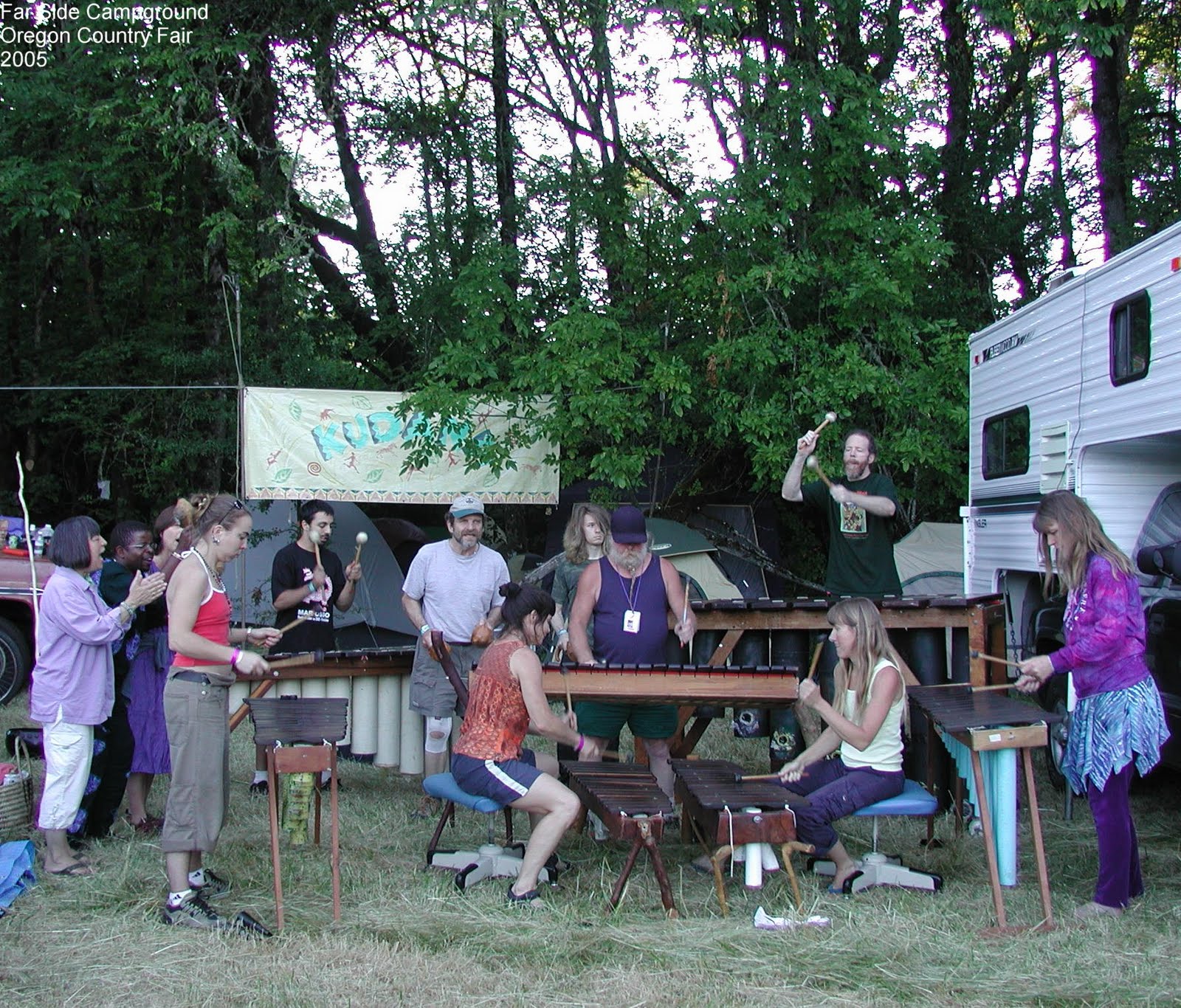
Oncar (seated at left) and his marimba band
Oncar's marimba band performed their annual concert for Far Side again.  Oncar is another of the Fair's Very Important Persons.  He leads the crew that is camped next to us.

An important thing to note, I believe, is that, despite the public perception, the Oregon Country Fair is not a crazy, drug-infested orgy.  Yes, there is drinking.  Yes, there is drug-use.  Yes, there is nudity.  And, yes, there is a lot of ganja smoking.  But folks, it is no more than what you would find at any other campsite in America.  And that's the truth, so far as I can discern it.

The only real distinction that I can make between the Oregon Country Fair and any other fair is that people are encouraged to make spectacles of themselves.  It's the costumes and the personae that people adapt specifically for the Fair that give it flavor.  But I'll write more about that later.

To be continued...

Monday, July 12, 2010

OCF 2010: Headlong into the bureaucracy (Pt. I)

Another tomorrow in the brief dusty march completed.  A sojourn through the hippie duality of hedonism and social awareness:  Oregon Country Fair, 2010.


Ed Knoph, a potential sorcerer and a friend of several years, came by the house on Tuesday night, and we loaded up my little errand-running city car so that we could get an early start on Wednesday morning.  This year, my fifth (non-consecutive) year as "official" Fair Staff, I was granted:
  • an Outta Site parking permit which meant that I could drive my car this year (a first);

  • a Significant Other Pass (S.O.P.)!  An S.O.P. is a plum.  It means that one is not recognized by Fair bureaucracy as working staff, but rather as the life partner of a working member of staff.  According to the law of the Fair as written, S.O.P.s are not required to work unless they so desire.
Ed and I were on the road out of Portland by 9am.  Leaving at that relatively early hour, we were afforded a leisurely pace, which is good.  The logistics of the Oregon Country Fair necessitate an enormous organizational structure.  The system seems to operate on the very brink of anarchy and collapse at all times.  So, it is good to approach the entrance to the labyrinth with as much saintly resignation as one can muster.  There will certainly be hassles. But, believe it or not, the system somehow works.  (Perhaps that's true of all bureaucracies.  I don't know...) 

Fair Admissions
Ed and I arrived at Fair Admissions sometime around noon.  Our names were located on the appropriate lists so that we could be awarded our identification bracelets.  One hurdle out of the way!

Next, we queued up for our parking permit.  Since it was still early, our wait was not long.

When we got to registration table, we were met by the old country hippie in charge of issuing parking permits.  A nice enough fellow.  By the lines on his face, I judged him to be in his late 50s.  He had a railroad cap on his head; his mostly-white-with-a-tinge-of-rusty-brown hair was pulled back in a pony tail.  He wore John Lennon wire-frames on the bridge of his bulbous nose.  His skin was a pinkish-red "farmer's tan."  He informed me that since I was designated an S.O.P., I was ineligible for a parking permit.

"Maybe the permit is listed in Ed's name" I said, hopefully.

He looked through the file again.  "Yeah, here it is," he said after a minute.  "Ed Knoph.  See the 'OS' by his name?  That means he's got an Outta Site pass."

"But wait!" said another bureaucrat, pointing at a different list.  "Look here!  According to this list, Ed Knoph has the initials 'FS.'  He's part of Far Side camp and doesn't get a permit."

Bureaucratic snafu!  The lists did not match!  We had arrived at a dead-end in the maze. 

All present were stymied.  Someone suggested that I call my crew leader.  Which I did.  But Mark didn't pick up.  I left a voice message on his cell.

Lost in the system
 Ed and I decided to unpack our camping chairs and take a seat in the shade of some nearby trees to await word from Mark. We sat and watched Fair Folk arriving in their hundreds.

My cell phone rang.  It was Mark.  "Hang tight," said he.  "I've been detained at work, but I'll be there as soon as I can."  (Mark lives and works in nearby Florence.)  Ed and I were reassured.  Mark Freeman is an expert at negotiating the Fair bureaucracy

It was roasting hot, and dusty, and muggy, but I was content enough, sitting in the shade.  People passed by, friendly and happy.  The Fair does that to them.

Oso came by, at one point.  Oso is a gruff, grizzly hippie, at least six and a half feet tall, shaped like a mountain.  He's got waist-length white hair.  He usually wears coveralls, with no shirt underneath.  He is a Very Important Person in the Fair hierarchy.

"Is that Oso?" I called as he went by.

He stormed past without looking.  "Oso died," he said.

"I know your nephew," I said.

He climbed into the driver's seat of his gas-powered Gator.  "'zat right?" he asked.

"Isaac," I said.

"That's one of 'em," he said.  Then he drove off.  No softening of that sour, angry visage.  I won't begrudge him his gruffness.  Any bureaucrat of significance must find some way to keep the petitioners at bay.

Ancient Greek patriarch, Pan, hangin' at Admissions
An hour went by, and Mark had not arrived.  As the sun declined to the west, our patch of shade grew smaller and more confining, like a shrinking spot of high ground in a flash flood.  "Try him again," said Ed.

Still no answer.  "You know, I wonder if we could just buy a permit?" Ed mused.

"Let's try," I said.

So, we approached the registration table again and asked, "Can we just buy a parking permit?"

"Sure," said the Fair official.  "Ten bucks."

Ed and I looked at each other.  "Guess we should have asked sooner," I said.

We had only just purchased our parking permit, affixed it to the inside of the windshield, and set off for our campsite when we saw Mark Freeman hustling toward Admissions, coming to our rescue.  "Too late, Mark," I said, grinning.

He looked exasperated.  Already.  The Fair was just getting started.  I've said it before, and I'll say it again:  Mark Freeman has the patience of a saint.

Ed and I drove to Far Side campground, which is about a 2 mile drive from Admissions.  There we were told by the gatekeepers that, due to some problems that had occurred the previous year, the Fair had come to an agreement with Oregon Department of Transportation.  This agreement meant that we could only drive in as far as the first fence, but under no circumstances could we drive all the way in to the camp site.  That meant we would have to haul our gear on foot for a good half-mile.

Long Tom all choked up
 Which we did.  It took us about 4 trips back and forth between the two of us.  It was close to 100o F, and the air was still and close.  Dust rose with every step.  We got our gear unloaded and piled into a flat patch under the trees in the camping area assigned to our crew.  Then we huffed it back out to the car and drove another 2 miles to the Outta Site parking field, where we parked the car for the weekend.  We then walked through the fairgrounds back to Far Side campground and finally set up our camp.

Look closely!  Can you see Ed in the Dragon's eye?
We got settled and sat down to relax just as dusk deepened into night.  I was exhausted, dirty, and sweaty.  But I'd run the bureaucratic gauntlet and come out the other side:  into the Fair.  Good times to come...
To be continued...

Tuesday, July 06, 2010

Off to the Fair

 Fair people love to party

This will be my last post for a while.   Tomorrow morning, I leave Portland to take part in the Oregon Country Fair, 2010.  The event, which I have written about previously, is a summer festival with lots of good music, good food, and fantastic arts and crafts.

 Main Stage, 2007

The event is open to the public from July 9th through July 11th.  I'll be part of Fair Security (and doesn't that make you feel secure?), so I'm arriving a few days early to help with the set up.

It has been 21 years since I first discovered the Fair.  I became enamored of it from the minute I entered the "magic 8" back in 1989 with my brother Eric and my friend Brian Davis.  I always experience a rejuvenation of spirit when I come home.  It is reassuring that events such as this can continue to thrive.

 Marimba jam at Far Side campground

The caliber of musicianship at this event is impressive and downright intimidating for casual guitarists like myself.  One year, I believe it was in 2001, fellow Mahatma Candy guitarist, David Thompson, and I arrived at the Fair, with our guitars slung over our backs, looking for people with whom we could jam.  As we made our way along the path, somewhere near Community Village, two young men were strapping on their guitars and invited us to sit and play with them.  As they tuned and ran through a few warm-up riffs it became apparent that neither Dave nor I would be able to contribute much:  both of them were professional-level musicians.  The moment was made quite awkward because a crowd had started to gather around us while we were setting up.  One of the two men pointed at Dave and I and said, "Are you folks ready to hear these guys jam?"  The crowd let up a cheer.  Dave and I looked at each other, and sheepishly withdrew into the crowd.  But we stayed to hear the two of them play.  And they were awesome.

"Hippie festival" is a descriptor often used in reference to the Oregon Country Fair, and I suppose that is accurate.  But most of the Fair people I know could not be described as "hippies" outside the confines of the Fair.  Which, of course, poses the question:  What is a hippie?

But I'm not gonna try to tackle that right now.  Just gonna go have some fun at the Fair.  I'll be back next week.  Have fun, all!

Monday, July 05, 2010

Mosey


A park in southeast Portland (at the intersection of Taylor and 17th) is named for Colonel Owen Summers.  Colonel Summers commanded the 2nd Oregon Volunteer Infantry in the Spanish American War.  He and the 2nd Oregon took part in suppressing the Philippine Insurrection, as well.

Having read Professor Zinn, I'm not inclined to view service in those conflicts favorably.  Those were misguided, imperialistic wars and nothing to be proud of.  But, according to the account written by Buck Private Joseph DeBurgh, a volunteer from Portland, it sounds as if 2nd Oregon performed admirably, that they were as humane as could be expected.  Second Oregon was nowhere near the Moro Crater Massacre.  I choose to believe that, had they been there, they would have done what they could to prevent it.  I'm that way about Oregonians.

Owen Summers
From what I have read about Colonel Summers (1850-1911), he wasn't a bad fellow either. A state legislator, a business man:  local boy does good.  He was orphaned at the tender age of seven, in Illinois.  He enlisted in the service of the Union against the Confederacy at 14 years of age.  Eventually, he settled in Portland.


There was a guy snoozing on the grass outside the fence at the Clinton Community Garden.  I imagine he was just passing through.  He and his dog had pulled up for a snooze in the grass.  It was a cool, gray day, but they had a nice napping spot, right in the middle of the lawn so that when the sun broke through, they got full benefit.  He was laying on his side in the grass, with his baseball cap over his face and his arm around his dog, who was zonked as well. 

I don't suppose anyone is much likely to name a park for that guy and his dog.

Nor for me, either.  C'est la vie, non?  I bequeath fleeting history to Colonel Wilson; he may have that for me.  My heart was more with the guy and his dog, catching some zees in the open air.

Friday, July 02, 2010

Grandfather Trilogy (Pt. III): The world they made

Dade, Eric, Ross, Jr. and Ross, Sr. at Disneyland
 The first meeting of my two grandfathers, Ross Cariaga and  Bob Metzger, was in Salem, Oregon, in July, 1961.  The occasion was the marriage of Ross's son, Ross, Junior (my dad), and Bob's daughter Bobbie (my mom).  They were two men from vastly different backgrounds, who found themselves in very similar places.  Each man was poised on the verge of middle age, watching as his kids began to leave the nest.

Bob Metzger and his three grandkids camping at Medicine Lake, CA

Bob came from the developing tradition of a native Oregonian.  He was descended from hard-working, ingenious Germans pushing westward from the prairies.  His were a noble, honest, and industrious people, emotionally reserved and stoic, but also kind, generous, and very, very responsible.  (Metzger family are often tormented by guilt.)

Ross came from the bleak life of agricultural labor.  He'd been his own man, with no social safety net to rely on beyond the friends he made along the way.  He had spent a lifetime forging a place for himself and his family on a new continent, thousands of miles from home.  Everything he had came from his own wit and initiative.  (Cariaga family are not patient people.)

Bob Metzger on family vacation in Utah

The last time my two grandfathers met was in January, 1992, in Klamath Falls, Oregon.  The occasion was the marriage of one of their two mutual grandsons, my brother Eric. 

The passage of time gives fuzzy edges to all memories, but I recall that it was winter in the Klamath Basin.  The air was cool, but not bitterly cold as it can be at that time of year.

It was the day before Eric's wedding when the plane carrying Grandpa Ross touched down at Klamath Falls Airport.

My fiancée and I had just finished checking in to our room at the Thunderbird Motel and we were standing in the parking lot with Grandpa.  Gray skies hung over our heads.  Grandpa was hat-less, wearing a tan-colored cardigan over his casual button-down shirt.  His slacks had perfect creases down each leg.  His gaze was cast downward at the faded blue-gray of the pavement.  He held one hand in his pocket, the other hung at his side.  "Is your Grandpa coming, son?" he asked me.

I said, "Yeah, Grandpa, he's coming on the train with my mom a little later today." 

Grandpa smiled to himself.  "Ah, okay, I'll go with him then," he said.

Grandpa Bob did, in fact, arrive later that night.  He looked appropriately Oregonian-casual when we picked him up at the train station in his corduroy pants and a light blue jacket.

The two men came face to face at Dad's house on Klamath Lake. They smiled as they shook hands. 

During that time of the wedding, the two were inseparable.  They made quite a pair, walking around Klamath Falls, having coffee at Denny's restaurant, chatting in the church pews at rehearsal:  the tall, broad-shouldered German, and the diminutive, brown-skinned Filipino.  It seems to me they smiled a lot as they talked.  It was as if they were two old friends who shared a lifetime of memories together, even though they had only met a handful of times. 

Ross, Jr., Ross, Sr., Don at my cousin Terry's wedding
When the wedding was over, the two men went their separate ways, never to meet again.

A year later, Grandpa Cariaga passed away.  Grandpa Metzger telephoned Eric when he heard the news.  "Eric, I'm sorry about your Granddad," he said.  Eric later told me that he could tell from Grandpa's voice that he was deeply moved by the news.  Five years after that, Grandpa Metzger passed, and his passing was the final adieu of my grandparents.

In some ways, Ross Cariaga, Sr. and Bob Metzger were polar opposites.  One was emotional, passionate, volatile; the other, staid, rational, understated.  In other ways, the two were very similar:  family men, doing their best to live up to their duty, as each of them understood it. Neither man had an easy life, but they had done more than just survive.  They had thrived.

The world I know is the world that was revealed to me by these two men.  It is a world revealed not only by the words of wisdom that they imparted to me, but also (indeed, more so) by who they were and by the way that they lived their lives. 

This completes the Grandfather Trilogy.

Thursday, July 01, 2010

Grandfather Trilogy (Pt. II): Ross Florentino Cariaga

Ross Cariaga, circa 1963

My paternal grandfather, Ross Florentino Cariaga, was born in the year 1913, in the Philippine Islands, which, at that time, was a territory of the United States. He was from the Ilocos Norte region (the same region from which came Ferdinand Marcos).  His mother died birthing him and so young Ross was partially orphaned at the very moment he entered the world.  Grandpa came to America at 17 years of age with other young friends from school, without his family and basically alone.  It was a decade before the Japanese invasion of the Islands in 1941, and when the war broke out, Grandpa was ten years in America, working as a migrant agricultural worker.  He harvested grapes, asparagus and pears all up and down the Pacific Coast for many years before wedding my grandmother, Jenny Rodriguez in 1938 and settling in Fresno, California.

Grandpa and Grandma had three children:  Rosalind (my Auntie Lina) born in 1939, Ross, Junior, (my father) born in 1940, and Donald (my Uncle Don) born in 1946.  The family lived in Fresno through the 40s and 50s before moving south to Coachella, California sometime around 1960. 

Me and Eric and Grandma and Grandpa Cariaga

Grandpa managed a camp for migrant workers (mostly Filipinos and Mexicans) outside Indio, California for many years.  Some of my earliest memories are of times out at "the Camp" as my family called it, playing with my cousins in the dry, oppressive heat of the Coachella Valley.

In the late 70s, Ross and Jenny divorced.  Sometime in the 80s, Ross remarried a Filipina, Gunding, with whom he remained married to the end of his life.  

In our family, Grandpa's word was not questioned.  All of his grandchildren learned from birth that Grandpa was to be obeyed and treated with respect and reverence. 

He was a small man, standing 5' 3", with a small stature.  But his expressive manner, especially when he was angry, would cause anyone to reel. He was notoriously impatient, and capable of quick, angry outbursts that would set you hopping to obey.  He would bark a command, in his heavily-accented English (the accent grew thicker when he was angry), thrusting his face forward, raising his eyebrows so that his forehead creased, flailing his hands.

Grandpa, circa 1992, a year before his passing

In my high school and college years, living in Klamath Falls, Grandpa would come visit every year.  At least once during each visit, Grandpa would spend an entire day cooking Filipino food for us all to enjoy.  Over time, we established the tradition that I would drive Grandpa to the various markets around town so that he could buy the food.  There were various meats, vegetable greens, lots of ginger, vinegar, soy sauce. 

We'd go to the market, Grandpa wandering through the produce section, or the butcher shop; me, pushing the cart behind him.  At intervals he would send me running off after some item or another.  For example, he would mutter:  "Son, go get the grapefruit," and as I started away he would say, "Get the big one."

I'd locate the grapefruit and carefully select the biggest one I could find, then come back with it.  "Like this, Grandpa?" I would ask, holding the fruit up for him to see.

"The big one!" he would shout, his eyes flaring, his chin thrust out at me.  "The big one!"  And, as I stood there flummoxed he would grab my hand and pull me over to the grapefruit stand where he invariably found a fruit that was bigger and riper than the one I selected.  There was always a warm affection behind his anger, and the entire oft-repeated exchange was funny to me.  Not that I dared smile.  Heaven forefend what that insolence might elicit!

Grandpa, the way I remember him
In later years, Grandpa became less animated, less volatile.  One of the last times I saw Grandpa, we had a  brief conversation about President Marcos.  It was shortly after Ferdinand and Imelda (ah, Imelda!) had been deposed and escaped to Hawaii. 

We were in the kitchen at Dad's house on Klamath Lake.  Grandpa was sitting at the kitchen table with the newspaper spread on the tabletop in front of him. I was standing by the cold wood stove.  The morning was warm and sunny, like most Klamath Basin mornings in the late spring.  We were sipping coffee.

The Islands were going through some unrest at the time and I was a young man, eager to draw firm conclusions from everything I saw.  "You know, Grandpa, one thing I'll say for Marcos:  he may have been crooked, but he kept the country together." Mentally, I braced myself for a rebuke.

Grandpa leaned back in the kitchen chair. His brown skin was dotted with liver marks.  A few sparse strands of hair still clung to his scalp at the very back of his head.  "Yeah, son," he said.  "He kept the country together."  He smiled, serenely:  a wide open-mouthed smile.  The deep wrinkles about his eyes grew deeper, more pronounced.  His smile said more to me than his words.  It was a gentle smile, tinged with a hint of resignation and satisfaction.  He made no attempt to correct what he surely must have thought to be the naivete of my opinion.  I had the sense that he was content with the man that I had become; the man that he helped shape.

I suddenly saw how much he had aged in the years since I had last seen him.

In 1993, Grandpa passed away in Palm Springs, California.  The Cariaga family lost our patriarch:  the man who came all the way across the wide Pacific Ocean to plant a seed in the New World.  We were all sad, of course.  But my own grief was assuaged by my faith that Grandpa, as he passed, was content with his legacy, with the progress of this thing he had started in America.  The gentle smile he showed me that morning in Klamath Falls had told me as much.

To be continued...

(Read Pt 1:  William Robert Metzger here.)