Showing posts with label Travel: Grand European Tour. Show all posts

Monday, September 21, 2009

Amsterdam at last (Pt. XXV)

Note to readers: This is the twenty-fifth and final part of a recounting of my Grand European Tour, taken in the fall of 1999. You can read Part XXIV here.

A journey completed
Amsterdam was very different when last I had walked along her filthy canals. Then, the streets had been alive with merry-makers, laughter, summer bustle, happy, carefree nights. Lights! Music! Action!

Now it was mid-November: dark, cold November.

Sixty-some days ab ovo, I returned to faces that were drawn and long and grim. These Dutchmen know the North Atlantic winter. Life was less easy now. Tourists were gone . . . mostly. Though not all.

I found a lonely room with a broken bed not far from Dam Square: dingy and dirty and cold, but good enough. The time had come to face some things. Let Amsterdam reveal what it will.

Assured now of my European savoir faire, I sat cross-legged under stone sculpture in Dam Square, smoking a cigarette, watching with mild disdain a countryman . . . certainly an American . . . swinging his shoulders like a New World rube . . . the workout sweat-suit . . . the baseball cap . . . I was like that when I first came here. Now I am European to all eyes, with my stone cold stare and my inability to be impressed.

He was Ernest (forthright but wary), a 6'7" black man from Providence, Rhode Island, ex-military, in his middle thirties, built like an NBA power forward. He picked me out of the hundreds of gray people in the Square, walked straight up to me, nary a moment's hesitation, and said "Hey, man? You're American, aren't you?"

Smile I must, and smile I did. How easily shattered, that preposterous delusion. "Yeah," says I, still American to the bone. Another travel friendship was forged on the spot.

We started with Indonesian food for lunch. Ernest had three weeks in Europe and no agenda. "Where should I go?" he inquired. My immediate reply, "Budapest," was uttered with a certainty I can never explain. At that instant, sitting in an Indonesian restaurant in Amsterdam, I knew that Ernest (forthright but wary) must go to Budapest. He nodded, recognizing the inexplicable conviction of my pronouncement.

From there, we descended together into seedy, lascivious Amsterdam: smokey coffee shops, labyrinthine alleyways, cold, damp stonework, and the stark, mercenary honesty of the sirens behind their plate glass windows. We were two Americans, reveling in the squalor and nobility of humanity.

Then, Ernest was off to Budapest, three-week Eurail pass in hand. We bid a mutual bon voyage.

Wilma (warm, smiling), whom I'd befriended in Rome, lived not far away in some small Dutch hamlet. I called her and we spoke, but could not muster the effort to reunite. No hard feelings, dear Wilma. Winter loomed apace. No need to venture beyond shelter.

And so, I was alone again in cold Amsterdam. I wandered wintry streets to return at night to my freezing room with broken bed, just off Dam Square.

I had completed a journey of almost 6000 miles, gathered in Viking fjord solitude, Prussian efficiency, and emerging Slavic dignity. I skirted through Alpine majesty, tracing the river's golden path across the valley floor from deific vantage. I descended, like ancient Hannibal into the realm of the Romans, saw their ruined cities, their broken pride scattered across Gaul. I experienced chic-humble duality of Spanish life by the Mediterranean. I endured insufferable arrogance, received astonishing kindness from the children of Vercingetorix. I sang for Belgians.

Triumph
And yet, no succinct moral lesson could I discern; no distilled observation on humanity's condition. Just these generalities: people are basically good; sooner friend than foe; and a hand offered in friendship is most often the surest and best approach.

On November 16th, I took the train from Central Station to Amsterdam Airport Schiphol:  a journey completed, a lifelong goal attained. Now, should I die, I could have no reason to complain.

At the end of it all, I knew two truths. I knew who I was. And I knew who I wanted to be. And best of all, those truths were not far apart.

Discovered
Note to readers: Thanks for taking this journey with me.

Wednesday, September 09, 2009

Brugge (Pt. XXIV)

Note to readers: This is the twenty-fourth part of a recounting of my Grand European Tour, taken in the fall of 1999. You can read Part XXIII here.

The Venice of the North
Autumn deepened toward winter. Days were dark and dreary; nights, freezing cold. I had one last stop before returning to Amsterdam to await the flight home: Brugge, in the west of Belgium, the "Venice of the North."

Wandering through that medieval maze of cobble-stoned streets I was amazed at Belgian resolution. Not the prospect of long dark winter nights, neither the dying of the year, nor icy winds from the English Channel could transform their steely grimaces to either smiles or long faces. They are a stalwart folk.

There were also many Brits from across the Channel taking holiday, drinking, carousing loudly, in this dreamlike setting: dreamlike, but not pleasant . . . eerie. As the sun sank, ghostly mists arose from the many canals that meander through the township, creating a surreal world. Only the discordant laughter of partying Brits prevented a complete trans-temporal reverie.

I got drunk again that night. Yes, drunk, after having shared beers with partying Brits in an outdoor cafe under a space heater. We talked politics, led by a Labor Party activist who sang the praises of Tony Blair. Later, in my room (a lonely enclave in an out-of-the-way alley), the hazards of introspection loomed. I looked in the mirror long and hard. I liked what I saw. Braving the reflection cast back at me from the bathroom mirror, I thought I glimpsed those things that others, those who like and admire me, might see. Dade: open-minded intellectual, world-traveler, generous, compassionate.

Then suddenly, at long last, I experienced some pangs of homesickness. I had a longing for my green, rainy home in the upper left-hand corner of civilization.

Medieval township in the autumn light
The next day consisted of solitary wandering through the streets and a boat tour of Brugge's many canals. In the thirteenth and fourteenth centuries, Brugge was a thriving and important seaport emitting Normandy grain, Gascony wine;  admitting goods from Genoa and Venice. Eventually, silt from the Zwin channel bottled up the harbor; Brugge was eclipsed by Antwerp as the premiere port of the north. Alas, Brugge! But just as every pleasure has an edge in pain, so too does every misfortune have its left-handed benefit. In the turbulent times to come, no armies would roll over Brugge; no Luftwaffe bombs would rain death on her denizens.

Memorial for fallen Canadians
Next day was my final day in Flanders. I climbed aboard a bus to tour those fields where Germans and Canadians and Brits died in their millions, sprinting from trench to trench, drowning in mud, dissipating in ghastly explosions, choking and dying in clouds of poisonous gas. It was here, in Flanders, that occurred the most vicious and senseless slaughters of the Great War.

Decrepit bunker crumbling amid the dead
My guide was Philippe Uyttenhove (passionate, knowledgeable) of Quasimodo tours. Eloquent and understated, he spoke with emotion of the butchery that had occurred on these fields some 85 years before. His own mother had fled her home, leading her children with those belongings she could pile onto her wheelbarrow, before advancing Germans could occupy her town. Even today, passions run deep in these parts. Philippe admitted to a hatred of Germans. "When I hear their language, I go berserk," said he. "They do not ride on my bus."

My face must have revealed my sad shock, my despair. "I won't pass it on to my children," he said, almost apologetically. "That wouldn't be right."

The unnumbered fallen
Many millions of artillery shells tore up these fields. An unknown number were buried in the mud, undetonated. Every year, Belgian farmers are killed when plows strike live shells buried in the ground. The residue of war continues to collect its tragic tax.

Somber, solemn graveyards give testament to the flower of a generation, plucked from humanity's bouquet before it could bear fruit.

That evening, I boarded the train for Amsterdam. The end of my journey was at hand.

To be continued...

Friday, August 28, 2009

Brussels - Waterloo (Pt. XXIII)

Note to readers: This is the twenty-third part of a recounting of my Grand European Tour, taken in the fall of 1999. You can read Part XXII here.

Nighttime in La Grand-Place de Bruxelles
A high speed ride on the Eurostar took me from Paris to Brussels. Zipping along in a bullet train at speeds approaching 200 miles per hour, I strummed my guitar until the coachmen told me, "You can't play music."

I arrived in Brussels, where a single occupancy room was to be had in the Jacques Brel Youth Hostel, not far from the station. These months of traveling made me leery of roommates. Those who are not afflicted with nocturnal log-sawing can never know the onus.

The hostel is named for Jacques Brel, the Belgian folk-singer, a Flemish Woody Guthrie. Early in his career he was humorous, irreverent, light-hearted. But later, wizened by age and disillusionment, he became morose, darkly philosophical. Monsieur Brel, Belgium's favorite son, epitomizes Belgian duality: optimism and resignation.

That night I strolled to La Grande-Place with all the 17th century Guild Houses packed side by side around the stone plaza.

Nighttime in November and, yes, it was cold. Restaurateurs plied their cuisine aggressively, recognizing the end of tourist season. I seated myself at a bistro, there to dine on cold lobster, shrimp, mussels, and oysters. I braved the challenge of raw oysters alone with none to witness my courage. Yes, oyster shooters. Mais, c'est finis. I have tried them. And that is enough.

Waterloo battlefield
The next day, I made a trip out to see the place where l'Empereur Napoleon Bonaparte was undone. His last gasp. His swan song. His failed encore. Waterloo. Here it was, in 1815 that Nappy, with his reconstituted Old Guard, fresh from exile in Elba, faced off with Duke Wellington and the British army.

The field is surprisingly small, considering that some 140,000 men came to lethal grips on it. For six hours, two armies grappled, bloodily, but indecisively. In the late afternoon, reinforcing troops were spotted hastening down the road that ran to the east. A moment of suspense . . . was it d’Erlon and the French? Or Blücher, with his Prussians?

When word came that the latecomers were Prussians, Napoleon, they say, muttered, "The one mistake I made in my life was deciding not to burn Berlin." From there, it was a foregone conclusion. At the crucial moment, the Old Guard made a valiant, desperate charge to break the Allied lines. Into withering fire, they set forth, hesitated . . . and broke! The sight of Old Guard flying in rout before the enemy changed the world. The mystique was ended. And so too Napoleon.

Marshal Ney leads the charge
After the battle, victorious Brits raised a mound atop which stands the triumphant British lion, one massive paw resting on the world. A proud and valiant people, those Brits.

Armistice Day Commemoration, Waterloo
I took a taxi back to the train station, to await the train to Brussels. A small, sober parade of Belgians, mostly elderly, marched to mournful music. It was Armistice Day: a commemoration of the end to the Great War in 1918. And, after all, these Belgians had suffered as much as any in that colossally unnecessary horror. Gray skies reflected the sad elegy. Nobility and resignation were written on the faces of these people, marching much as the determined Old Guard must have marched. But for these, there was no hope of glory or recognition: just small voices defying history, begging us to find another way.

I played guitar in the common room of the Jacques Brel hostel that night. I played with a heavy heart, pulled down by the many hands of the unnamed dead.

To be continued...

Wednesday, August 19, 2009

Paris (Pt. XXII)

Note to readers: This is the twenty-second part of a recounting of my Grand European Tour, taken in the fall of 1999. You can read Part XXI here.

L'Arc de Triomphe at night
The end of my tour approached and still I had no answers to haunting, half-formulated questions about identity, about future, about truth; just a sadness, an anxiety. But, also I felt a buoyancy, a faith in the goodness of people brought about by the many kindnesses, open smiles, recognitions of shared humanity.

"Je suis perdu," Louis XVI despaired as he knelt at the guillotine in the Concorde. "There is never any end to Paris," countered Papa Hemingway, some 130 years later, during his self-imposed exile. Both statements resonated as I stepped off the train and into the City of Light.

And thence to a pensione near l’École Militaire, right in the heart of it all; in the heart of this thing they call "Paris." This was not my first visit, but may as well have been: much more than a city, this. An astounding organism: risqué, holy; mocking, gentle; impervious, haughty, humble and vulnerable . . . Paris.

That first night, I wandered through the Place de la Concorde, but heard no lamentations. The ghostly victims of the Terror have passed beyond. Paris rains washed away the blueblood stains of the haughty aristocracy. Now, sidewalks teem with the ultra-chic and their pampered dogs, whom they disdain from cleaning up after.

I walked up the Champs-Élysée, stopping along the way at a bistro for aperitif. It was cold and rainy. But it was Paris. Solitude fit my mood. I was alone at the center of the Western world.

M'lady is amused?
And so on, into the next day, where I started with a visit to the Louvre: this time with resolve to get beyond thousands of paintings into other previously unseen wings of this mammoth collection of the jewels of human creation. To no avail . . ..

I made an obligatory homage to Leonardo's mysterious Mona, behind the thick glass and the laser beam security, forever beyond our grasp, but taunting us with her enigmatic smile. Then Vincent, Manet, Monet, and Rafael drew me in. No, there would be nothing beyond these masterpieces. They defy you to pass them by. It can't be done.

Four hours later the senses finally succumbed. One eventually becomes insensate, dazzled into submission. And so, it was back out into the Paris streets to visit Our Lady, enthroned on her ait in the Seine.

Stained glass in Notre Dame Catedral
Nearly 200 years in the birthing, she sits now, venerable and majestic. I crept in, trying with every fiber of my agnostic being to pay sufficient reverence. I sat in a pew in the "silent" section with the Catholics and sent out my hopeful prayers to a possible God. His Holy Silence was my reward.

Memorial to Holocaust victims
 Tucked away in the shade of the glory of Our Lady, at the very tip of the islet, there is a solemn memorial to French victims of Nazi atrocities. The panzers rolled through the streets in June 1940 after vanquishing the celebrated French army with astonishing ease. Lay no blame with the brave French soldiers or the thousands of Legionnaires in their trenches along the Maginot Line. Rather, fault the stultified thinking of Marshal Pétain and the arrogant and slothful French general staff. Be that as it may, 200,000 French citizens fell victim to the cruelties of National Socialism.

For me, American wanderer, standing in a tunnel on an ait in the Seine, it was another humbling and solemn moment: surrounded by the spirits of slaughtered thousands.

Michael whipping up on Lucifer on the Left Bank
Enough! Time to lighten up!

And so, I rode le Metro to the Left Bank where Hemingway and Fitzgerald and Gertrude Stein hung out and drank their wine and dined on escargot et fromage et pain while they wrote their masterpieces. It was here that I found the young people and the smiles and the lighter spirits that defied the gray November skies.

Nappy and me
Returning to my pensione, I circumnavigated l’École Militaire, Louis XV’s proud endeavor to make warriors out of the gentry. And there was the diminutive Corsican general staring down at me with his stern expression. But the passage of two centuries has robbed his visage of its power to daunt. Now, he seems an historic curio.  L'adieu, l'Empereur.

Chance romance in Versailles, France
The next day, I caught the train to Versailles, the seat of French power at various times and the site of the decadent palatial estates of the decadent French royalty. There I met mother-daughter team Katie-Teresa (elegant, high maintenance) from Arizona. Also Andreas (amiable, over-bearing) and Elena (modest, beautiful), the newly-weds on their honeymoon from Greece. Andreas and Elena had been to Disney World Paris the day before. Elena (modest, beautiful) had twisted her ankle at Sleeping Beauty's castle and could not walk.

Packed to the gills in the Hall of Mirrors
And so, Andreas and I took turns carrying her piggyback from the train station to the entrance of the Versailles estate. There, we obtained a wheelchair and took turns pushing Elena (modest, beautiful) through the over-crowded display of opulence and decadence.

Small wonder that the proletariat rose up back in the day, and exacted such a bloody toll on their overlords. The lavish gardens, the many-mirrored hallways spoke of obscene and unnecessary luxury. But, truth be told, it was far too crowded to enjoy the spectacle. At every twist and turn in the palace was an endless sea of people, stutter-stepping through.

More enjoyable was the interaction when we five went to lunch afterward. Andreas (amiable, over-bearing) brought his huge Greek personality to bear. "No, no, I order for you," he insisted. "I order for all of you! I know what you will like." He pushed the menus out of our hands. And order he did. And it was good. Andreas didn't so much speak as shout. He chain-smoked, dragging off his cigarette between mouthfuls of food. But so good-natured was he that neither I nor even elegant, high maintenance Katie-Teresa could object.

In the Musée d'Orsay
We said goodbye to Andreas (amiable, over-bearing) and Elena (modest, beautiful) at the train station. Then it was back to Paris with Katie-Teresa (elegant, high maintenance). Together, we went to le Musée d'Orsay. A somewhat rushed visit. We had only an hour or so until it closed for the night. Nonetheless, there was much to see and enjoy, and d'Orsay was not so overwhelming as the Louvre.

The Gates of Hell
Afterward, I bade farewell to Katie-Teresa (elegant, high maintenance) and returned to the now-familiar state of solitary reflection. I wandered alone through the streets of Paris. As the days grew short, the skies heavy, my thoughts turned from carefree rail riding to contemplation on the next stage of life. I spent another night in my pensione, considering, imagining, reflecting . . ..

Paris . . . there is never any end to Paris. Je suis perdue.

To be continued...

Monday, August 10, 2009

Bordeaux - St. Lo (Pt. XXI)

Note to readers: This is the twenty-first part of a recounting of my Grand European Tour, taken in the fall of 1999. You can read Part XX here.

French border guards waved me through when I pulled out my American passport. They couldn't be bothered.

These were the early days of November: the skies were cloudy, the temperatures, cool. Winter was approaching. Days grew shorter and colder. In my spirit there grew a wistful anticipation that my time on the road, my soul-searching pilgrimage, my Grand European Tour, was coming to its end. But not yet . . . not quite yet.

I went to Bordeaux in the Aquitaine: famous for its wine and moderate climate.

Bordeaux
Neanderthal came to the region, long ago, as evidenced by the cave discovered in 1881, where muscle-bound slow-witted Neanderthals buried their dead 80 thousand years before. But Cro Magnon, who came later, had little tolerance for competitive species, even older biological cousins. And so, Neanderthal went the way of the woolly mammoth and the mastodon and the saber-toothed tiger:  fallen before the onslaught of those who came in the wake of retreating ice.

The Celts settled the area around 300 BC, a mere two centuries ahead of marauding Roman legions, who subjugated and enslaved in order to control the tin and lead abundant in the area. Then the Romans too passed away. The Celts remain.

For me, Bordeaux was a brief sojourn. I hopped off the train, had a look around, made a quick pass through the museum, where French-only exhibits had little to offer. I knew already about Eleanor of Aquitaine and her role in the struggle for the throne of England. Eleanor wed Henry II in a political marriage that, nonetheless, produced children, including closeted homosexual Richard, Coeur de Lyon, and much-maligned King John. Richard and John were pawns in the high-stakes game between their parents. Eleanor spent most of her marriage locked up in a tower. Henry (schemer par excellence) knew well that softhearted kings were most often revered posthumously.

I went in search of companionship to a restaurant somewhere along the way. I entered, was greeted by a waiter. "S'il vous plaît, monsieur, parlez-vous l'anglais?" I inquired.

"Non," he said. He shook his head and turned away.

"L'espagnol?" I inquired.

"Non!" he replied, favoring me with a condescending smile. I spoke no French. He was through with me. I shrugged and left, angry.

Janelle, moi, et Rob
 But I found another place, where they were showing American basketball on the television and, where I met an Australian father and daughter (Rob and Janelle) touring France together. We shared pleasant conversation and food. They thought I was American Indian. I didn't deny it . . . they seemed to want it so much.

I spent one night in a drab hotel room. In the morning, I walked through a nearby open-air market where I haggled with an African immigrant over a hat to replace the one I had left in the church in Bergen. And then, I was back on the train. I was on my way to St. Lo where I hoped to see the Normandy beaches.

***

Normandy was where Eisenhower swallowed hard and pulled the trigger. Even that late in the war, he still feared the mighty Wehrmacht. He needn't have fretted so much. The cream of the German war machine was even then being destroyed on the Russian steppes, a thousand miles and more to the east. Never to diminish their bravery, but those GIs, Brits and Canadians, were facing mostly conscripted Ukrainians or Byelorussians.

On arrival, my hopes for a battlefield tour were dashed quickly enough. The beaches, Omaha, Juno, Sword, Gold, and Utah, are separated by miles. And I with no car, nor  desire to rent one, settled instead for a walk around the town. Just to see.

Memorial to Allied troops in WWII
St. Lo was the nerve center for Wehrmacht defense against the Allied beachhead. For six weeks, they fought in hedgerows. Pitiless fighting. St. Lo herself was reduced to rubble. Now, 50 years later, she is a nondescript little town in gentle French farmland.

St. Lo
The big rugby match was on tayvay when I went to the hotel to book a room. The clerk behind the desk would not be bothered, so intent was he on the game: France versus Australia with the World Cup at stake. Here is a key, monsieur. Go, go. You can pay tomorrow. His eyes never left the television screen.

Alas, France lost the match. When I arose the next morning to catch the train to Paris, there was nary a soul to be seen at the desk. I set the key on the counter and left. I'm sorry France lost, mes amis déçus. But merci for the complimentary night's rest. I am off to Paris. Au revoir.

To be continued...

Friday, July 31, 2009

San Sebastian (Pt. XX)

Note to readers: This is the twentieth part of a recounting of my Grand European Tour, taken in the fall of 1999. You can read Part XIX here.

Un buen día en San Sebastian
I first heard rumor about San Sebastian while attending the classical music concert in Vienna with the two bickering sisters. An elderly Spanish gentleman told me of it. "Es muy linda, mi ciudad. Debes ir alla," said he.

From Barcelona, I took the night train north. It was absolutely packed. Spaniards of all shapes and sizes were going home after El Día de los Muertes: including the shepherd with the tall walking stick, the dapper older gentleman with wife and daughter; modest Catholics all. I had entertained hopes of stretching out and sleeping on the ride up. False! Each seat was occupied. In the seat across from me was Australian Jay (down-to-earth surfer dude).

Jay and I, both veteran travelers, conversed on the ride since sleep was unattainable. We struck up an immediate friendship in that way that travelers have. When the train stopped at San Sebastian we debarked, assuming, without ever having discussed it, that we would room together while we were there. We were approached by a matronly Basque doña before we even left the platform. Un dormitorio, nos dijo. We followed her to the pensione.

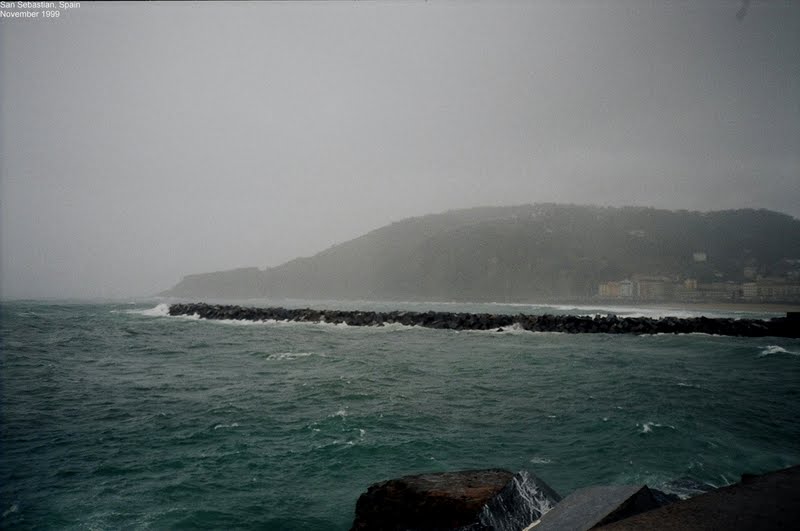
Hace mucha lluvia
The North Atlantic raged that day: a heavenly inundation on the Bay of Biscay. It was just as well that, due to the sleepless night of rail riding, we both were exhausted and spent much of the day in repose. But we did do some dashing about, from portico to eave, later in the day to capture a sense of the town.

San Sebastian is in Basque country. The town had fallen in 1808 to Napoleon's Grande Armée forces.

But Nappy, the diminutive Corsican, would learn all too well how fiercely those denizens of Iberia guard their liberty. Guerrilla actions, partisan activities bled l’Armée, as it lumbered around rugged Spanish terrain. The Spaniards sapped French strength, leaving them spent and demoralized when Russians, Austrians, English, and Germans brought the tyrant to bay in Paris.

Later, in 1935, Franco's Nationalists imposed the fascist jackboot on San Sebastian in the Spanish Civil War. Resentments still simmer.

Jay (down-to-earth surfer dude) and a beautiful Basque girl
Basques hide a separatist movement, intermittently violent, within their fold. But no anger did I discern in these proud people. They were friendly, distinctly good-looking, like my Basque friends Tony (funny, happy raconteur) and Tina (dark haired, dark-eyed beauty) back home.

We found an Irish pub in town where we met Australians Jody and Troy, in Spain on their honeymoon. We swilled Guinness stout, with its silky, animated head. The evening was spent gulping Irish ale in Spain with Australians, listening to stories about sharks in Australia, recounting past loves, proclaiming hopes for the future. Van Morrison played on the stereo.

Honeymooners Jody and Troy
"Van's the Man," said I.

"Van is the Man," Jay agreed. "He's never let me down."

We ended the evening very drunk.

Next day, the weather was beautiful: sunny and cool, blue skies, blue water. Jay and I climbed to the top of the hill that overlooks the bay, where sits the old Cathedral. In the courtyard was a wishing well. A crone crouched at the top, raising coin-filled buckets from below, where her son gathered the castaway hopes of passing tourists.

Jay and I clowning around at the water's edge
A tale she told, in a ghost of a voice, all in Spanish. I did my best, but can make no guarantees: earlier in the century, a fire swept through the town, consuming everything. The people did their best, but in the end could not contain it. They retreated to the Cathedral, there to pray and hope for the best. After a long night, they emerged to find that the town was devastated but miraculously the flames had not touched the church. San Sebastian, the patron saint, had sheltered his people from the consuming fire. Or so the old crone believed.
Las aguas de la Bahía de Vizcay
San Sebastian was easy, peaceful. Jay (easy-going surfer dude) and I sat out by the sea wall, watching the tide go out. He, pondering what awaited him in Australia: a woman he loved, another that loved him. I, pondering what awaited me back in the United States: who was I? What was I? Two men at similar places in their lives: a transitional pause, the brief idle of life's gears before the clutch engages.

The next morning I left for France. Jay stayed in San Sebastian another day. Onward. Jay, I hope you found it, whatever it was.

To be continued...

Wednesday, July 22, 2009

Barcelona (Pt. XIX)

Note to readers: This is the nineteenth part of a recounting of my Grand European Tour, taken in the fall of 1999. You can read Part XVIII here.

En la cima de la Rambla
Rail transport from Arles to Barcelona required two different train changes at various points in the journey across southern France. The end of a long day of riding trains and waiting in stations found me in a pensione right off la Rambla in Barcelona. Whatever powers impel the Universe had placed me there on the weekend of El Día de los Muertes. The place was hoppin', as they say.

Legend has it that Hamilcar, the father of Hannibal, the bane of Roman imperial aspirations, and a passable general in his own right, founded Barcelona some 300 years before the commencement of Gregorian history. Barcelona is a beautiful city, on the Mediterranean coast. She was a bastion of Spanish Republicans in that country's tragic civil war, the last city in all of Spain to submit to Franco and the Fascists. Today, she is a city of immense culture, gentle climate, beautiful beaches, and great food!

La Rambla, the pedestrian mall, stretches down from la Plaza Catalunya all the way to the beach, with everything from high-end shops and posh restaurants at the inland terminus, to live sex shows and street drug peddlers at the seaward. A constant flow of people moved up and down.

Street performer along la Rambla
The first night, I dined on paella (pah-AY-ya), that delightful concoction of saffron rice, mussels-in-the-shell, Spanish sausage, and various vegetables. Delicious! Among the many charms of Barcelona, the food—Paella of course! And never have I encountered coffee as robust and rich, nor orange juice so naturally sweet and fresh.

The city was teeming with young people out to have a good time. I met a California girl, Maria, and a young woman, Kate (troubled, troubling) from Australia. Together we walked la Rambla. Kate and I ducked into the live sex show out of sheer curiosity, where an attractive couple had dispassionate, mechanical sex in a bed on a stage. Boring really.

Barri Gótic
Next day, wandered around the Gothic Quarter, Barri Gótic, just taking it all in. This area is the oldest part of the city. The site of the first constructions erected by Roman frontiersmen. Lots of musicians and a solemn Gothic church.

La iglesia del Barri Gótic
 During the day, I met yet another Australian woman named Kate (self-deprecating, funny). Together we went to the Picasso museum. I have to say, Picasso is often beyond me. Whatever it may say about underdeveloped art appreciation skills, I find that his work too often impresses as childish stick-figure drawings. I have great appreciation for his more accessible works, though: Massacre in Korea, for example, or his Cubist experimentation, or even his "Blue Period." Pablo Picasso, a Communist, a genius, and some say, a coward. I withhold judgment.

Kate (self-deprecating, funny) and I made our way from the museum to the beach and there parted ways. It was early afternoon and the city was shutting down for daily siesta. I made my way back to the pensione and, adapting quickly to the Spanish rhythm of life, napped.

Tara and I on la Rambla
That evening I went to dine at world-famous Les Quatre Gats restaurant: alone and feeling lonely. I noticed a beautiful young woman by herself at the table behind me:  sharply dressed, a streak of blue through her hair, Chinese ancestry. I introduced myself. She was Tara (fashionable, sophisticated) from Toronto. We shared a table, went for a walk along the shore and up la Rambla then agreed to meet the next day for sightseeing.

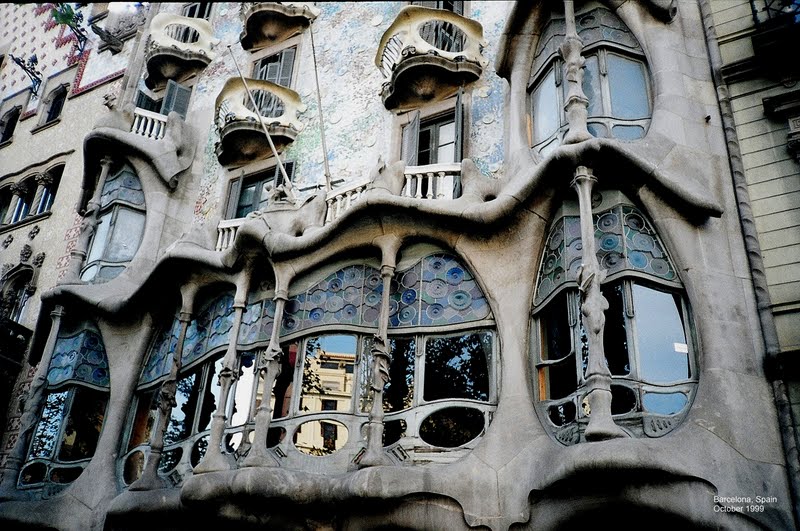
La Casa Milá by Gaudi
That day we saw the works of Gaudi, the genius architect, whose footprint has come to identify Barcelona itself: curves and angles, shapes molded by the natural world and reminiscent of houses and buildings from a Dr. Seuss book. Fascinating.

La Casa Milá
Gaudi remained unpretentious and humble to his death. Run over by a streetcar in 1926 at the age of 73, he was taken by mistake to a hospital for the indigent. Gaudi insisted that he remain among the poor, where he died three days later.

Sagrada familia church
Gaudi lived a Catholic, and died a Catholic, even as his famous masterwork, la Iglesia de la Sagrada familia, near the center of the city was still under construction.

Sagrada familia church, closeup
Together, Tara and I wandered through, climbed to the top, agape. Never had I seen anything like it. Never before, never since.

Sculpture in la Sagrada Familia church
 We looked out on the expanse of Barcelona below us: there the blue of the Mediterranean; there, the arid hills of the hinterland. The sun was kind;  the city relaxed amid its bustle.

Arches in la Casa Milá
 After la Sagrada familia, we went to Park Güell, also designed by Gaudi for the city he loved. A beautiful park with another breathtaking view. We bought ice cream from a vendor and ate a picnic lunch.

That night, I took Tara to the train station. She was off to Madrid. "I'm very glad to have met you," she said. She said it with kindness and gratitude and a touch of sadness: all of which I understood. One never really travels alone, whether riding the rails through Europe or journeying through life. Never. If there is no living, breathing companion to share the road, then there is loneliness. Loneliness becomes one's companion. Tara set off to her platform; I soon lost sight of her in the meandering crowd. Goodbye, Tara. Fare thee well.

For me, there was one more night in Barcelona, one more meal of paella and orange juice. It was the last day of October. El Día de los Muertes. I savored the gifts that Barcelona had given me.

In the morning, I arose late, sipped fresh, incomparably rich Spanish brewed coffee, then waved goodbye to this city with which I had fallen madly in love. In the afternoon, I caught the train north.

To be continued...