
Last year, Maty and I rented and watched a movie called "Grizzly Man." This is a documentary film directed by Werner Herzog that relates the life and death of one Timothy Treadwell.
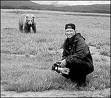 |
| Timothy Treadwell, the Grizzly Man |
Treadwell was an amateur environmentalist and grizzly enthusiast who worked as a waiter in the winter, then went to camp amongst the grizzly bears in the Katmai National Park and Preserve in Alaska. Treadwell, a failed actor, spent 13 summers living in close proximity with the grizzlies, ostensibly to study them and protect them. During that time, he video-taped much of his experience, of which tapes Werner Herzog makes great use in his moving and bemusing film.
As the film progresses, one witnesses incredible scenes of Treadwell approaching and touching bears, tapping a bear cub on the nose while the sow watches warily in the background, confronting bears that approach him. As I watched these scenes, some primal instinct was triggered in me, something that made me nearly paralyzed with dread. Treadwell seems blithely unaffected by any concern for survival, seems almost brazen in his death-defying antics.
Ultimately, Treadwell and his girlfriend, Amie Huguenard, are killed and eaten by one of the bears he so dearly loved. An audio recording of the attack survived, and, although it is not played during the film (thankfully) we learn that the attack lasted six eternal minutes and was as horrifying as one might imagine.
It is easy to dismiss Treadwell's death as the folly of a romantic fool, made all the more tragic because of the incidental death of Huguenard. (We learn from excerpts from Treadwell's diary that Huguenard expressed a fear of the bears and urged Treadwell to leave, at one point saying he was "hellbent on [his own] destruction.")
But, try as I might, I could not come to terms with Treadwell's death by writing him off as insane. He was certainly unbalanced, as any objective viewer will note from Treadwell's rants and his fairy-tale perception of nature. But there was a demon that haunted him. Huguenard's words ring true when Treadwell recounts his struggle with alcoholism and drug abuse.
In my own life, I have encountered persons, some of them dear friends, who have turned to drugs or alcohol or anorexia or sexual promiscuity as a means of expressing the contempt they have for themselves. (In the darker eras of my life, I've even practiced some of these vices myself.) It is tragic and horrifying to watch a person willfully destroy himself (or herself).
 |
| What a way to go! |
I imagine that Treadwell saw the grizzlies as possessing all those traits he found lacking in himself: purity, nobility, strength, innocence. Truly, he is a tragic figure. Like the innumerable others who are compelled to destroy themselves, in the end, Treadwell didn't get what he deserved, but, heart-breakingly, he got what he was asking for.
A haunting, unforgettable film....I recommend it.

