Sunday, May 05, 2013

A very strange sight in Tiananmen Square and photos from the Forbidden City

Mausoleum in Tiananmen Square
Massive Tiananmen Square is the beating heart of Beijing. The huge plaza, capable of containing a million people, is bordered on the north by the Forbidden City, where Chinese emperors of the Ming and Qing dynasties ruled China for 500 years. On the eastern side of the plaza is the National Museum and on the west is the Great Hall of the People. In the middle sits the Mausoleum of one of the 20th Century's most influential persons, Mao Zedong --that is, Chairman Mao.

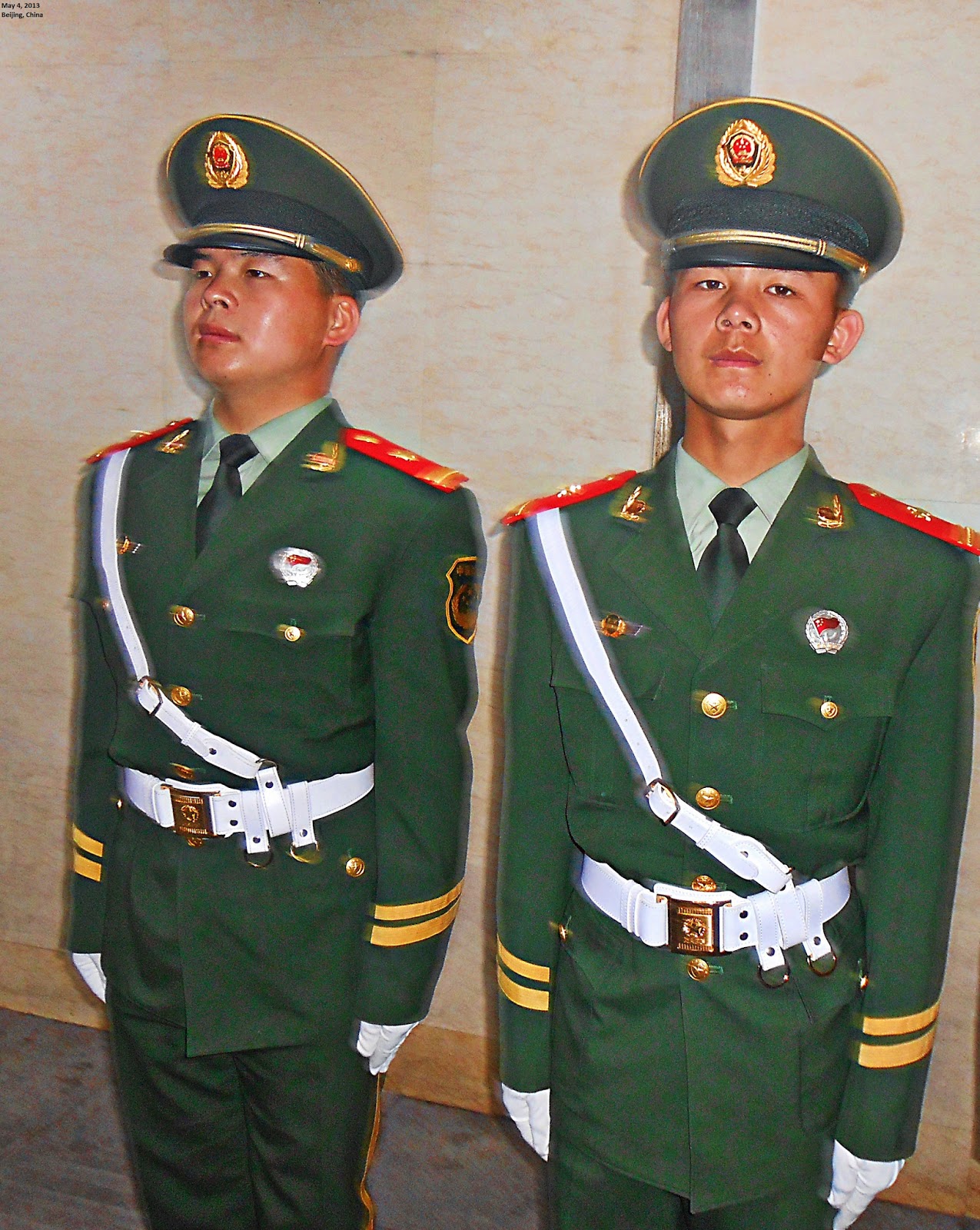
Chinese honor guard. It's all business with these guys.
I'd heard that the good Chairman yet lies in state, 37 years after his death, and that was confirmed by Sunflower, our tour guide. Whatever it may say about the morbid demons that drive my curiosity, I found the opportunity impossible to resist. So I overcame Brother Calee's indifference and we queued up to join eager Chinese citizens in the long but fast moving line.

What the hell was that?
Cameras and cell phones are forbidden in the mausoleum, so we handed ours over to Sunflower, who remained outside. I toyed with the idea of bringing my little digital in with me to try and squeeze off a shot on the sly, but you know, the stone-faced soldiers that stood at the entrance convinced me that it was not such a good idea.

We joined a human river that flowed steadily into a vast, dim hall. A red curtain obscured the southern wall. The high ceiling was lost in shadow.

Two streams of humanity flowed across the marbled floor, never pausing, past a glass case. Within it was a strange sight. A figure lay horizontally on a platform, as if in sleep. A bright red flag, adorned with yellow hammer-and-sickle covered the figure from mid-chest down. A yellow glow seemed to emanate from within the head. The experience had a dream-like quality that makes my recollection uncertain, but I do remember catching a whiff of recognition in the shape of the head, the soft flesh under the chin, the round face, crowned by the high forehead and the crescent of dark hair. Yes, that's what I remember from the photographs. My God! Is it real?

Modern Chinese artist's interpretation
The whole thing was over before I could fully grasp it. The human river flowed inexorably and soon enough we found ourselves back out in the sunlight. Sunflower met us at the exit and we went from there to tour the Forbidden City.

But it was a strange sight. A very strange sight, indeed.

Chairman Mao. I'll be damned. That was Chairman Mao.

That guy in the portrait looks familiar...
Photos from the Forbidden City


Back to Shanghai tomorrow!

Saturday, May 04, 2013

Bullet to Beijing

Brother Calee checks out the Chinese countryside
On Friday, we hopped the bullet train from Hongquio Railway Station in Shanghai, bound for Beijing. Although it is a journey of some 760 miles, we covered that distance in roughly 5 hours. That's an average speed of 152 miles per hour, for those keeping track. It was a smooth easy ride and it made me all the more convinced that President Obama's plan to restore and improve American passenger railways is the way to go.

High-rise apartments springing up everywhere
We arrived at Beijing South railway station where we were met by our Chinese guide for the day, a young woman who went by the American name of Maggie. We took a drive into the city, got checked to our hotel, then set out to see some sights with the remains of the day.

Middle Kingdom rolling past at 150+ miles per hour
Our first stop was Beihai Park behind the Forbidden City. This 1000 year old park was originally established as an imperial garden. It's proximity to the Imperial grounds made it the site of an important and sad event. Specifically, the demise of Chongzen, the last emperor of the Ming Dynasty in 1644.

During Chongzen's reign, catastrophic floods plagued China and caused much suffering in the countryside. But the Emperor angered his people with Marie Atoinette-like callousness and disdain for their suffering. Resentment smouldered and then burst aflame when 800,000 peasants rose up and assaulted the Forbidden City. Chongzen, facing death at the hands of the angry masses, chose an easier way out. He and his eunuch consigliere hanged themselves from a cypress tree at the foot of a hill in the Imperial Garden. Two solemn stones mark the spot.

Thus ended the Ming Dynasty after 276 years of rule.

'Twas here where they found Chongzen and the eunuch
It's a beautiful park. A serenity hangs over the grounds like the gaze of the Buddha, despite whatever tragedies may have played out there over the centuries.

Temple on top of the hill
Our tour through the park wandered like a lazy river. We climbed up and down many stone steps. Each path revealed new marvels.

Nine Dragon Screen
Our wandering eventually led us to the Nine Dragon Screen. This exquisite piece of art was built in 1756, but you'd never know it by the vividness of the colors. Each side of the screen depicts nine dragons. The number is significant, although I can't remember why.

Dog tired and bedazzled
At this point, I was exhausted, but we pressed on to take in a few more sights from Beijing's cacophonous streets.
Drum Tower
Including the ancient Drum and Bell Towers. It was at the Bell Tower, you will recall, where a deranged Chinese pushed a foreign visitor to his death during the 2008 Olympic Games.

Bell Tower
Our day ended with dinner at the highly-acclaimed and elegant Peking Duck restaurant. We had (what else?) the roast duck. Calee thought it fabulous, but I was too tired to care one way or the other.

Sniff... poor little duck
Three days until I head for home. I'll tell ya, this has been one fantastic trip.

Thursday, May 02, 2013

Chinese art, both ancient and modern

Porcelain vase from the Qing Dynasty depicting the Eight Immortals
On Tuesday, a visit to Shanghai Museum (free admission!) exposed Calee and me to art from this ancient civilization, much of it dating back thousands of years.

Statuette of Buddha. Can't recall the details, I'm afraid. But, trust me, it's old.
At first, I attempted to catalog my photos so that I might write about them for this blog. But there were so many images to be captured, so many artifacts, paintings, sculptures, wood carvings, and porcelain masterpieces to view, that the task was beyond me. In the end, these photos will have to provide inadequate testimony to the priceless treasures within the museum.

Delicately painted porcelain


After Shanghai Museum, we took a stroll through People's Square, as told. There, we came upon an art exhibit by two of China's modern artists: sculptor Gao Xiaowu and painter Joyce Ho. Their work demonstrates how art continues to evolve over these human millennia and how, in this ever-shrinking world, outside influences have penetrated the ancient Middle Kingdom.

Joyce Ho


Gao Xiaowu


Tomorrow, Calee and I catch the high-speed (average 170 miles per hour) commuter train for Beijing. So, this post is my sign-off from Shanghai. I hope you've enjoyed these photos. Check back later for sights and stories from China's capital.

'Til then, just for grins, here's some food for thought from China's premier philosopher, Confucius:

“If you think in terms of a year, plant a seed; if in terms of ten years, plant trees; if in terms of 100 years, teach the people."

Wednesday, May 01, 2013

Lookin' for love in People's Square

Coi pond in People's Square
Not far from the Shanghai Museum (admission gratis!) in the Huangpu district is an urban park known as People's Square. In addition to being the site of the headquarters of Shanghai's municipal government, People's Square is also a recreational area and an amusement park.

On Tuesday, after a rewarding morning in the museum (more about that in a future post) we wandered through the park on a pleasant, relatively smog-free day. It was the second day of China's three-day May Day celebration and the park was full of vacationing Chinese.

Proud papa makes a pitch for Junior
On one stretch of paved walkway that snaked along the edge of a coi-filled pond, we came upon what is known among Shanghai residents as the match-making market.

Eligible young woman
All along the path, paper flyers announce the statistics (name, age, height, weight, profession, languages-spoken, and so on) of eligible young Chinese. The idea is that parents or grandparents worried that life might be passing young Bao-yu by, can put together a data sheet and hang it on this public "bulletin board" where it might be seen by other parents or grandparents with similar concerns for Meng-yao.

Wait a minute... how'd this guy get in there?
It seems a strange way, to our Western sensibilities, to establish to a domestic arrangement. But really, it is our modern method that is the historical anomaly. Most marriages in the world, even today, are arranged by family quite apart from the sentiments of the principles.

Swapping info. Could we be looking at future in-laws?
Does it work? I guess that would depend on what one means by "work." But we all know that the American courtship process, where star-struck youngsters get hitched out of love is positively foolproof, eh? (Cough, cough.)
Noodle stand
Besides, in China, even if you're one in a million, there are still a thousand others just like you.

Bunnies for sale
Just like life: goes up slow, comes down fast

Sunday, April 28, 2013

The Temple of Peace and Tranquility

Jing'an Temple
Take a 30 minute walk from Lakeville Regency apartments, where Westerners make their high-rise homes, past Xintiandi Mall, where you can buy high-end clothing, across Huaihai Road, choked with taxis, buses, and cars, take a left on clamorous West Nanjing Road, go past swanky Plaza 66, where Nike and Prada have their Asian headquarters, and you will come upon the Temple of Peace and Tranquility.

3D fresco depicting scenes from the life of the Buddha
Jing'an Temple has stood here, a lotus flower amid the changeful waters of Shanghai, for nearly 800 years. (Coming, as I do, from the youngest part of the Western World, it is strange to think that while Europeans were jousting with armor and lance, golden-robed monks were even then burning incense in the courtyard and bowing to the Stone Buddhas.)

Ornate woodwork

The temple has been razed and rebuilt more than once in that time. Most recently, in 1972, it was partially consumed by fire. But just as the essence of being is rebirthed, so too, the temple.

More fresco
Buddha in the Hall of the Great Hero

Incense offering

Pungent smoke fills the courtyard

I dreamed of eternity
Golden lions

Fresco on an exterior wall

Tower in the courtyard